
Attic insulation cost
By Insulation Report Editorial. Last reviewed August 2026. How we research this.
In brief
A 1,200 square foot attic blown to R-49 with fiberglass runs about $2,600 to $3,200 installed. That is $2.18 to $2.66 a square foot, with material at store price. We built those figures from four parts, not from other cost pages. One, the BLS May 2025 average wage for insulation workers.
Two, a multiplier of 2.0 to 3.0 on that wage, for what a worker costs beyond pay. Three, 9 to 12 crew-hours per 1,000 square feet. Four, the published price and coverage of a named bag of blown fiberglass. Parts two and three are estimates.
Material is two thirds to three quarters of the job, and it costs the same everywhere. So where you live moves the total far less than most cost pages claim. Check your attic first. If you are within about R-10 of the ENERGY STAR level for your zone, air sealing usually beats more depth.
Installed cost by attic size and target R-value
What the money buys, staged on the driveway
A machine, a hose long enough to reach the far corner, and enough bags to hit the depth. Two of those three are the material line; the rest of the quote is time.
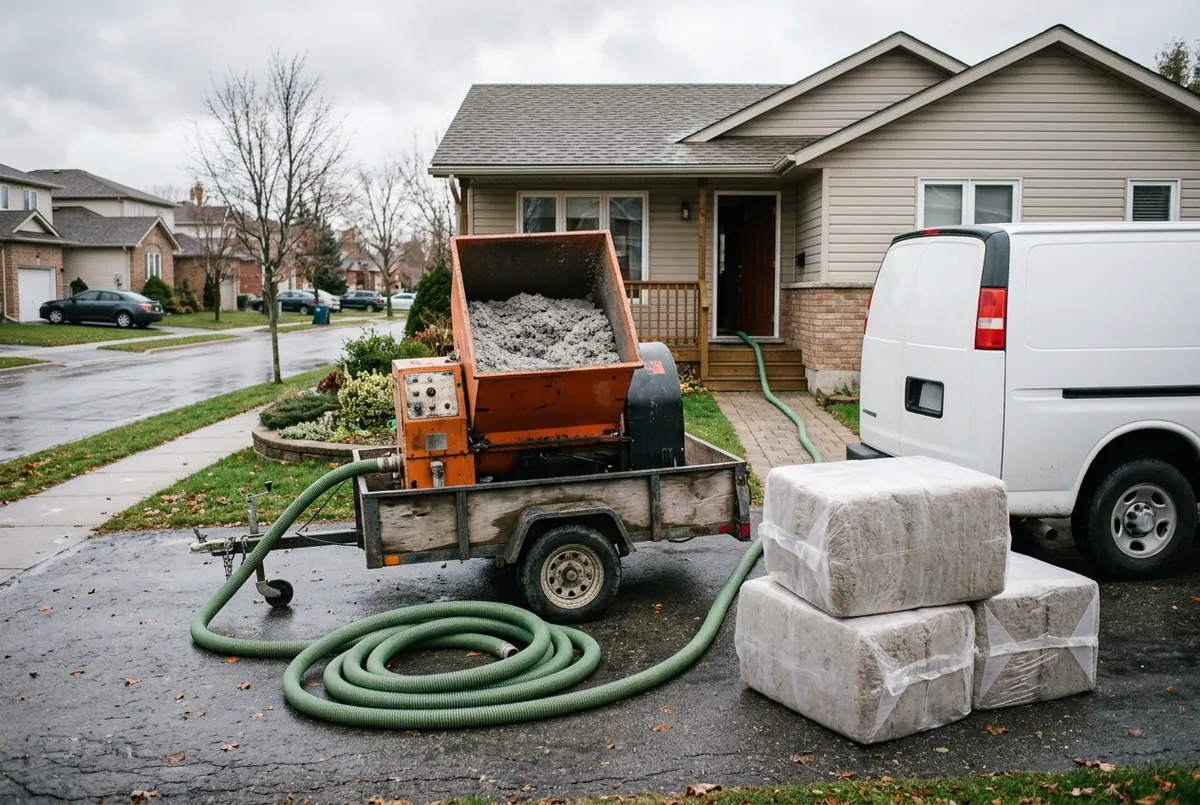
All three targets come from ENERGY STAR. R-38 is for zones 2 and 3 where some material is already down. R-49 is the full target for zones 2 and 3. And R-60 is the target for zones 4 through 8, which cover most of the country.
Figures: Insulation Report Cost Model, August 2026. Blown fiberglass into an open attic you can get into. Labor at the national average wage. Material at store price. Rounded to the nearest $50. The crew-hour rate and the multiplier on wages are estimates, so every range here is an estimate too.
| Attic floor area | To R-38 | To R-49 | To R-60 |
|---|---|---|---|
| 1,000 sq ft | $1,750 to $2,250 | $2,200 to $2,650 | $2,600 to $3,050 |
| 1,200 sq ft | $2,100 to $2,650 | $2,600 to $3,200 | $3,100 to $3,700 |
| 1,500 sq ft | $2,650 to $3,350 | $3,300 to $4,000 | $3,900 to $4,600 |
| 2,000 sq ft | $3,500 to $4,450 | $4,350 to $5,300 | $5,200 to $6,150 |
The model is linear in floor area, so per square foot the bands are the same at every size: $1.75 to $2.23 at R-38, $2.18 to $2.66 at R-49, and $2.60 to $3.07 at R-60. A real market has minimum job charges the model does not carry, so expect small attics to run above these bands more often than below. For a blown-in job priced on your own floor area and target, the attic insulation calculator runs the same figures.
Where the 2021 IECC model code calls for R-60, section R402.2.1 accepts R-49 over the whole ceiling if the insulation carries over the wall top plate at full height, which normally means a raised-heel truss. Energy codes cover new building and work done under a permit. They do not usually cover adding insulation to an attic you already have. Which edition applies where you live depends on your state, and often on your city. Your local building department is the only authority on it.
How these numbers are built
Most cost pages quote a national range and cite nothing. Every figure on this page comes from the Insulation Report Cost Model, August 2026: four inputs, each with a stated basis, so you can check the arithmetic and swap in better numbers where you have them.
| Input | Value | Basis |
|---|---|---|
| Trade wage | $26.32/hr national mean | Measured. BLS OEWS May 2025, SOC 47-2131, Insulation Workers, Floor, Ceiling and Wall |
| Burden multiplier | 2.0 to 3.0 times wage | Estimate. The ordinary construction range, not a measurement |
| Crew hours | 9 to 12 per 1,000 sq ft | Estimate. Secondary trade guidance for a two-person crew |
| Material price | $67.58 per 27.5 lb bag | Measured. Owens Corning AttiCat blown-in fiberglass, retail listing read 2026-08-07 |
| Material coverage | 110.7 / 68.5 / 39.5 / 31.8 sq ft per bag at R-19 / R-30 / R-49 / R-60 | Measured. Manufacturer's published coverage, read 2026-08-07 |
How it works. Crew hours rise with floor area. The wage gets multiplied to cover what a contractor carries on top of pay. That is payroll tax, workers compensation, liability insurance, the blowing machine, vehicles, overhead and profit. The bag count comes from the maker's coverage chart at your target R-value. Two of those four inputs are estimates. The tables here carry that through. They are brackets for judging quotes, not prices.
One bias is deliberate. Material is priced at the retail shelf, and a contractor buys below it. The size of that trade discount has not been measured, so rather than guess, the model charges full retail and says so. The practical effect is that the low end of every range here is conservative: a real quote can undercut it honestly.
The coverage chart also records something most calculators miss. Each bag yields less as the target rises: R times coverage per bag runs 2,103, then 2,055, then 1,936, then 1,908 at R-19, R-30, R-49, R-60. That is the self-compression the U.S. Department of Energy describes in loose-fill: R-value does not scale strictly with depth, because the material settles under its own weight. A calculator that divides a target R by a fixed R-per-inch overstates what you get. This model interpolates the manufacturer's own chart instead, which puts a bag at about 31.8 square feet at R-60, interpolated between the published points (the manufacturer's own R-60 figure, about 31.8, agrees).
Why region matters less than cost pages say
Cost content usually asserts a large regional swing. The components do not support one. On the 1,200 square foot reference attic to R-49, material is about 78 percent of the low estimate, and material is priced nationally: the same bag costs what it costs in every state. Only the labor slice, roughly 22 percent at the low end, moves with geography.
The BLS May 2025 wage for insulation workers runs from $19.62/hr in West Virginia to $37.64/hr in Washington, a gap of 92 percent. Feed both extremes through the model on the reference attic and the installed low estimate moves by about 16 percent, because the wage only touches the labor line. A near doubling of the wage becomes a difference of a few hundred dollars, not a doubling of the job. The full 51-row version of this comparison, every state ranked with its BLS wage, is the insulation cost index.
Figures: BLS OEWS May 2025 state average wages, run through the Insulation Report Cost Model, August 2026. The model-low column carries the model's estimated crew hours and wage multiplier, so it is an estimate.
| State | BLS mean hourly, SOC 47-2131 | Model low, 1,200 sq ft to R-49 |
|---|---|---|
| Washington | $37.64 | $2,866 |
| New York | $31.90 | $2,742 |
| Hawaii * | $33.91 | $2,786 |
| Pennsylvania | $26.28 | $2,621 |
| Texas | $23.97 | $2,571 |
| Utah | $21.00 | $2,507 |
| West Virginia | $19.62 | $2,477 |
* Derived, not measured. BLS surveyed too few insulation workers here to publish a wage for
SOC 47-2131. So we scale the national trade wage instead, by how this state's
all-construction wage compares with the national one. Wages May 2025, from src/data/labor-index.ts. Model low uses the same estimated crew hours and wage
multiplier as the table above.
Real quotes vary by region more than this, but the honest reasons are mostly not the wage: they are local demand, minimum job charges, disposal fees and how busy the season is. When a quote is dramatically above the band, the explanation worth hunting for is scope, which is the next section.
What makes a real quote higher than the table
The model prices one thing: blowing fiberglass into an open, accessible, empty attic. Real attics add lines, and each of these is a legitimate reason for a bid to sit above the band.
| Line item | Why it costs real money |
|---|---|
| Access | A tight hatch, low clearance or no walkway slows every hour of the job. The crew-hour estimate assumes a typical attic, not a crawl |
| Baffles and dams | Soffit vents need baffles before loose-fill goes near the eaves, and the hatch and any flues need dams. Skipping them blocks ventilation, so their absence from a cheap bid is a defect, not a saving |
| Air sealing | Sealing the ceiling penetrations before burying them is where much of the actual energy saving lives, per DOE guidance, and it is the line most often excluded. Ask whether it is in, itemized, or absent |
| Removal and disposal | If the old material has to come out, that is a job of its own with its own pricing. See what insulation removal costs before assuming it is included |
| Contamination | Rodent damage, mold or suspected vermiculite change the job entirely, and the last of those is a separate licensed trade. Start at the removal guide if any of these applies |
Is this quote fair? A four-step test
Run any bid through this before signing or rejecting it. It ends in a verdict, not a shrug.
- Get the scope in writing. Floor area in square feet, target R-value, bag count or coverage, and an in-or-out answer on air sealing, baffles, removal and disposal. A one-line quote with one number cannot be judged, so if the contractor will not itemize, stop here and get one who will.
- Divide the price by the floor area. That gives you a per square foot figure to compare against the model band for the quoted target: $1.75 to $2.23 at R-38, $2.18 to $2.66 at R-49, $2.60 to $3.07 at R-60, material at retail.
- Apply the two corrections. A quote can sit below the band honestly, because the contractor pays less than retail for material. A quote sits above the band honestly when the extra is named: hard access, baffles, air sealing, removal. Subtract the named extras and re-compare the base line.
- Verdict. Base line within or below the band with a full scope: accept it. Above the band with the difference itemized and explained: fair, compare it against one more itemized bid and take the better scope, not the lower number. Above the band with no itemization and no named reason: decline it and get another quote. The table is conservative at the low end, so a bid it flags as high is worth challenging.
Get quotes for attic insulation
Tell us the job and your ZIP. We pass it to a licensed contractor who works in your area.
A marketing service, not a licensed contractor. Insulation work is performed by independent licensed local contractors.
- What happens next?
- Your request goes to a licensed insulation contractor near you, usually within about an hour during the day.
You may not need this
We do not sell insulation and we do not install it, which is why this section exists. A real share of the people pricing attic insulation should not buy any this year.
- You are within about R-10 of your target. Insulation has strongly diminishing returns: the first inches over a bare ceiling do most of the work, and the last few repay slowly. Going from a nearly bare deck to R-30 saves far more than going from R-38 to R-49. Measure before you spend: the depth checker turns inches into an R-value range and compares it with the ENERGY STAR level for your climate zone.
- You have not air sealed. Insulation slows conduction and does nothing about air moving through gaps around light fittings, plumbing stacks, top plates and the hatch. DOE guidance treats sealing the ceiling plane as the partner job, and on a leaky ceiling it is usually the better first spend. Insulation blown over an unsealed ceiling underperforms its label.
- The existing material needs attention first. Wet, moldy or rodent-contaminated insulation should come out before anything goes over it, and burying a problem costs the new material too. Remove or add over runs that decision.
- You are about to reroof or rewire. Work that disturbs the attic wastes the new insulation. Sequence the trades, insulate last.
The rest of this section
This page gives the installed total. These break the total apart from two directions: the material side and the labor side.
- Blown-in insulation cost: per square foot, per bag and installed, with the arithmetic that converts between the three.
- Attic insulation installation cost: what you are paying a crew for, why a billed rate is a multiple of a wage, and what quotes commonly leave out.
- Insulation cost per square foot: every material priced in the same unit at the same R-value, and the two mistakes that make most per-square-foot numbers wrong.
- Cost to insulate a 2,000 sq ft attic: priced both ways, because a 2,000 square foot house usually has a smaller attic than that.
And three priced by material, each one built on a retail listing read on a stated date rather than on an average.
- Batt insulation cost: what rolls and batts cost per square foot, and why two products at the same R-value price differently.
- Spray foam attic cost: the board foot, how to judge a foam quote with it, and what a kit really costs per square foot of ceiling.
- Radiant barrier cost: cheap by the roll, and why that does not make it a substitute for insulation.
Related guides
- Insulation types compared: R-value, cost and where each one fits
- R-value: what it measures and what you need
- How much insulation do I have? The depth checker
- What insulation removal costs
- Do it yourself, or hire? The arithmetic
- Air sealing, the line most quotes leave out
- Attic ventilation, the other line most quotes leave out
Common questions
How much does it cost to insulate an attic in 2026?
Blown fiberglass on a 1,200 square foot attic to R-49 models at about $2,600 to $3,200 installed, with the material priced at retail. Across the sizes and targets on this page, from 1,000 square feet at R-38 up to 2,000 square feet at R-60, the modeled range runs roughly $1,750 to $6,150. Two of the model's inputs are estimates, not measurements: the crew hours, and the multiplier on wages. So treat every figure as a bracket for checking quotes. It is not a price anyone owes you.
Why is the material priced at retail if contractors pay less?
Because the retail shelf price is the one figure a reader can verify today, and the trade discount has not been measured. A contractor buys the same bags below shelf price, so the material line in these tables overstates what the contractor actually pays. That bias runs one way: it makes the model conservative, which is why a real quote can come in under the low end of a table here and still be honest. When a checked supplier price exists, the model will use it and this page will change.
What R-value should I be paying for?
ENERGY STAR recommends R-30 for an uninsulated attic in climate zone 1, R-49 in zones 2 and 3, and R-60 in zones 4 through 8, which cover most of the country. An attic that already has 3 to 4 inches gets a lower target, R-49 in zones 4 through 8. Those figures are based on the 2021 IECC model code. Energy codes cover new building and work done under a permit. They do not usually cover adding insulation to an attic you already have. Which edition applies where you live depends on your state, and often on your city. Your local building department is the only authority on it.
Is there a tax credit for insulation in 2026?
The federal Section 25C credit is not available for insulation placed in service after December 31, 2025. What remains live are the state-administered Home Energy Rebates from the Inflation Reduction Act, the HOMES and HEAR programs, and insulation and air sealing qualify under both. Availability differs by state, programs open and close, and some have waitlists, so check with your own State Energy Office before counting any rebate in a budget. No page on this site will quote you a rebate amount, because a cached amount goes wrong within weeks.
Why do two quotes for the same attic differ so much?
Usually because they are not quoting the same job. Four lines differ most often. Air sealing, which is often left out. Baffles at the eaves. Removal or disposal of the old material. And the target R-value itself, which one bid may quietly set lower. Ask each contractor for the floor area, the target R-value, the bag count or coverage, and a yes or no on air sealing, baffles and disposal. Most of the gap closes once the scopes match.
Is it much cheaper to blow the insulation in myself?
Cheaper, but by less than it looks. Labor and its burden are about 22 percent of the model's low estimate; the rest is material, which you buy at the same retail shelf price the tables here use, while a contractor buys below it. You also take on the blowing machine, baffles, and the prep work in a hot attic. It is a genuine option for a walkable, accessible attic that needs no removal and no air sealing. For anything else, the gap between doing it yourself and hiring narrows quickly.