
Best attic insulation: every material compared
By Insulation Report Editorial. Last reviewed August 2026. How we research this.
In brief
For an ordinary open attic you can get into, the best insulation is blown-in fiberglass or blown-in cellulose. The honest difference between them is small. Both are loose fill. Both get blown to depth over the whole floor. Both fill uneven framing far better than batts. And both cost the least per unit of R-value of anything on this page.
Fiberglass handles damp a little better. Cellulose gives more R per inch, so it hits the same target at a shallower depth. That default is wrong in four cases. A cathedral ceiling or a heated attic needs spray foam or dense batt work at the roofline.
A rodent history needs cleanup before anything goes in. A constantly damp attic needs the water fixed first, not a material chosen around it. And a radiant barrier is not an alternative to any of these, because it has no useful R-value. If the existing material is dry and clean, topping it up beats replacing it, whatever it is.
The comparison, in one table
The four materials, side by side
Texture is most of the difference a homeowner can actually see. What separates them on an attic floor is R per inch, how they handle gaps, and what they do when they get wet.
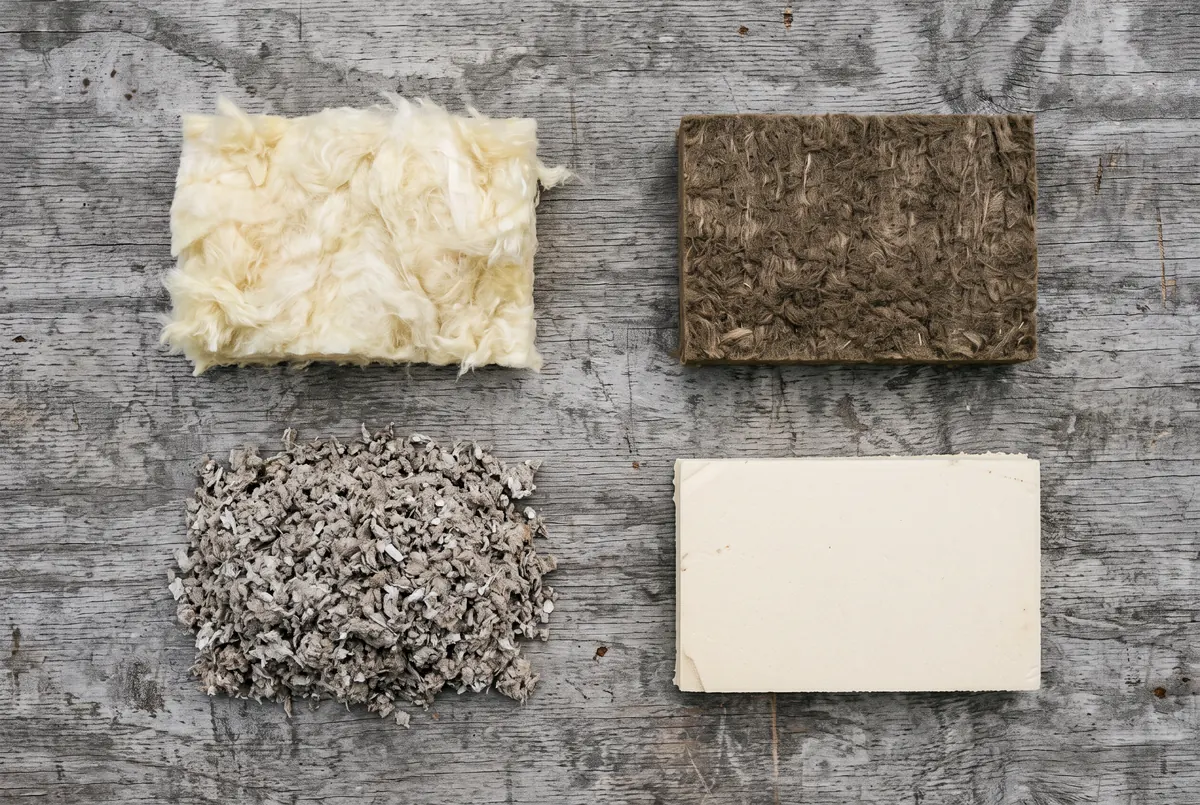
Every figure below is a range. R per inch really does vary with density, product and how it went in, so a single number would be false precision. The depth column shows the inches needed to reach R-49. That is the ENERGY STAR recommendation for an attic in climate zones 4 to 8 that already has 3 to 4 inches. To see where that target comes from, and to pick your own by climate zone, see the R-value guide.
| Material | Form | R per inch | Inches to R-49 | Notes |
|---|---|---|---|---|
| Blown-in fiberglass | Loose-fill (blown) | 2.2 to 2.7 | 18.1 to 22.3 | Settles. Coverage per bag is product-specific; read the bag label. |
| Blown-in cellulose | Loose-fill (blown) | 3.2 to 3.8 | 12.9 to 15.3 | Settles more than fiberglass. Installed depth should allow for it. |
| Loose-fill mineral wool | Loose-fill (blown) | 2.8 to 3.7 | 13.2 to 17.5 | Non-combustible. Less widely stocked than fiberglass or cellulose. |
| Fiberglass batts | Batt | 2.9 to 3.8 | 12.9 to 16.9 | Gaps and compression cost real R-value. A poorly fitted batt underperforms its label. |
| Mineral wool batts | Batt | 3.3 to 4.2 | 11.7 to 14.8 | Dense, holds its shape, non-combustible, sheds water rather than absorbing it. |
| Open-cell spray foam | Spray foam | 3.5 to 3.7 | 13.2 to 14 | Contractor-installed. Vapor-open, so the assembly design matters. |
| Closed-cell spray foam | Spray foam | 6.0 to 7.0 | 7 to 8.2 | Contractor-installed. Acts as a vapor retarder and adds rigidity. |
R per inch ranges are settled, aged values from published material data. We carry them in our reference data with sources recorded. The depth column is worked out from those ranges, best case to worst case. Two warnings. For loose fill, DOE notes that it gets denser as it goes deeper, so R-value does not rise in step with depth. The coverage chart on the bag is the authority for any specific product. For spray foam, the R-49 column is math, not practice. Foam is specified by the contractor to a designed thickness, usually at the roofline rather than piled on a floor. Labeled R-values for insulation sold in the United States come from standard tests such as ASTM C518, under the FTC R-value Rule. That is why the label, not a general table, settles any disagreement.
Blown-in fiberglass
Molten glass spun into loose tufts. It gets blown to an even depth over the attic floor. It is light, it does not feed mold, and it dries out better than cellulose after a leak. The trade is depth. At R-2.2 to R-2.7 per inch it needs 18.1 to 22.3 inches to reach R-49. That is more than some low rooflines can hold near the eaves. Wear a fitted respirator, goggles and gloves. The fibers are an irritant.
Cellulose vs fiberglass settles the choice between the two. It runs on published weight, settling and bag coverage figures. For the machine and the method, see blown-in attic insulation.
Blown-in cellulose
Shredded recycled paper. It is treated with borate fire retardants, made to specifications such as ASTM C739, and blown in the same way fiberglass is. At R-3.2 to R-3.8 per inch it reaches R-49 in about 12.9 to 15.3 inches. So it fits a high target where clearance is tight. Against that, it soaks up water, settles more, and weighs more on the ceiling. Same respirator, goggles and gloves. The dust is heavier.
Cellulose vs fiberglass puts numbers on each of those trades. It also shows the extra depth the settling chart asks for on the day.
Mineral wool, loose-fill and batt
Fiber spun from molten rock or steel slag. It comes as loose-fill and as dense batts. Unlike cellulose, it needs no added fire retardant, because it is non-combustible as it comes. Water runs off it rather than soaking in, and the stiff batts stay where they are put. Against that, it costs a tier more than fiberglass and cellulose, and fewer yards stock it. On a plain open attic floor it buys little the cheaper loose fills do not.
Mineral wool carries the sourced fire test results. It also has the clearance rules around a masonry chimney, a flue and a recessed light. That is where the fire behavior earns its money.
Fiberglass batts
The pink or yellow rolls everyone pictures first. They are the right tool for bays that are regular, reachable and empty: knee-wall backs, the attic hatch, a small addition. They are the wrong tool for a big open floor. Wiring, plumbing, bracing and uneven joist spacing force cuts. Every gap and squashed corner costs real R-value. A blown material flows around all of it.
Blown-in vs batts works that format question through. It prices what a small gap costs you. Fiberglass batts in an attic covers the fit and the faced-batt mistake.
Open-cell spray foam
A two-part polyurethane foam that expands into a soft, vapor-open layer, at roughly R-3.5 to R-3.7 per inch. Its real job is the underside of the roof deck. There it insulates and air seals in one pass, which brings the attic inside your heated space. On an open attic floor it buys nothing loose-fill does not, at several times the price. It is contractor work only: mixing ratios, cure times, and a stretch you have to stay out of the house.
Spray foam in an attic covers the material, the covering the model code asks for, and how long you stay out. Open-cell vs closed-cell settles which type to buy.
Closed-cell spray foam
The dense sibling, at roughly R-6.0 to R-7.0 per inch. That is the highest R per inch of any material on this page. It cures rigid and acts as its own vapor retarder. So it wins wherever there is no room for depth: cathedral ceilings, flat roofs, the tight triangle at the eaves. R-49 in about 7 to 8.2 inches is something nothing else here can do. It is also the most expensive material per unit of R-value on this page. And it buries your wiring, your roof deck and any future leak hunt. Contractor work only, same as open-cell.
If foam is already the answer, open-cell vs closed-cell is the next question. It carries the board-foot math for checking a quote.
Radiant barrier is a different product, not a competitor
A radiant barrier reflects radiant heat rather than resisting conduction, so it has no useful R-value per inch and cannot be counted toward an R-value target. It is measured differently from bulk insulation and the two do not add together.
That is why it is absent from the comparison table: there is no honest number to put in the R per inch column. It is a supplement, not a substitute for depth on the floor, so if a pitch for foil is competing against a pitch for inches, buy the inches. The radiant barrier page covers the physics, the narrow case where it earns its keep, and the claims to reject.
What they cost, relative to each other
This table ranks rather than prices. Per-material dollar figures need a measured price for each material, and the only one measured here is blown fiberglass. The built-up installed numbers, with the method and its estimates stated, are at the cost guide.
| Material | Installed cost per unit of R | Who installs it |
|---|---|---|
| Blown-in fiberglass | Lowest tier | Homeowner with a rented blower, or a contractor |
| Blown-in cellulose | Lowest tier | Homeowner with a rented blower, or a contractor |
| Fiberglass batts | Low on material, expensive in fitting time done properly | Homeowner |
| Mineral wool, either form | A tier above the fiberglass and cellulose defaults | Homeowner for batts, contractor for loose-fill |
| Open-cell spray foam | High | Contractor only |
| Closed-cell spray foam | Highest | Contractor only |
| Radiant barrier | Not comparable: it buys no R-value | Homeowner staple-up is common |
The decision, by attic
Find your row, take the recommendation. If two rows apply, the one describing a problem (moisture, rodents) wins, because material choice comes after the attic is sound.
| Your attic | Do this | Realistic DIY? |
|---|---|---|
| Open, accessible, existing material dry and clean | Air seal the ceiling, then top up with blown fiberglass or cellulose to your zone's target | Yes, with a rented blower and a helper |
| Bare or nearly bare floor, good clearance | Air seal, baffle the soffits, then blow fiberglass or cellulose to the uninsulated-attic target for your zone | Yes, same route |
| Low clearance at the eaves or a shallow roofline | Blow cellulose for its higher R per inch; where full depth cannot fit at the perimeter, have a contractor spray closed-cell foam in that band | Partly; the foam band is contractor work |
| Moisture problem, past or present | Fix the roof or the ventilation first, then insulate; prefer blown fiberglass or mineral wool over cellulose near any spot with a leak history. See mold in attic insulation | The moisture fix usually is not |
| Rodent or pest history | Have the contaminated material removed and the deck cleaned before anything new goes in. See rodent-contaminated insulation | No; this is cleanup work, not insulation work |
| Cathedral ceiling, knee walls, or ducts in the attic | Move the boundary: closed-cell foam at the roofline in cold climates, open-cell in mild ones, mineral wool or high-density batts in accessible knee walls | No for foam; batt knee walls, yes |
| Loose vermiculite anywhere on the floor | Stop. Treat it as potentially asbestos-containing per EPA guidance and read the vermiculite page before touching anything | No, under any circumstances |
If no row forced a change, the default from the top of the page stands: air seal, then blown fiberglass or cellulose over whatever dry, clean material is already there. Whether the old layer should ever come out first is its own decision, and the remove-or-add-over guide runs that test in five steps.
You may not need new material at all
A material comparison invites the assumption that something must be bought. Often nothing should be. If the existing insulation is dry, clean and free of pest damage, it is still doing its job, whatever unfashionable material it is, and the question is only whether there is enough of it. Measure before you shop: the depth checker turns inches into an R-value range and compares it with your zone's recommendation. Within about R-10 of the target, which is this site's estimate rather than a measurement, more depth is a slow payback and air sealing the ceiling plane is usually the better spend.
Topping up a decent base costs a fraction of tearing out and starting again. And switching materials buys you nothing on its own. R-49 of cellulose and R-49 of fiberglass hold heat the same. We do not sell insulation and we do not install it. That is why we can tell you the cheapest material on this page is the one already in your attic.
Get quotes from licensed insulation contractors
Tell us the job and your ZIP. We pass it to a licensed contractor who works in your area.
A marketing service, not a licensed contractor. Insulation work is performed by independent licensed local contractors.
- What does it cost?
- A 1,200 square foot attic blown to R-49 runs about $2,600 to $3,200 installed, from this site's own cost model dated August 2026. Two of its parts are estimates, so read it as a range and not a quote. See the full working and the price by attic size.
- What happens next?
- Your request goes to a licensed insulation contractor near you, usually within about an hour during the day.
The rest of this section
This page compares the materials against each other. Each of these goes a level deeper into one of them: how it is installed, how it fails, and how to check the finished job.
- What insulation do I have?: name it from the hatch by color and texture, and what each answer changes about the job.
- Blown-in attic insulation: the machine, the method, settling allowances, and how to inspect a finished blow.
- Fiberglass batts in an attic: where they work, where gaps and compression cost you the label R-value, and the faced-batt mistake.
- Radiant barrier: what it does, why it has no R-value to add to your total, and the narrow case where it earns its keep.
- Mineral wool: stone wool batt and loose-fill, what the fire rating is worth in an attic, and why it rarely wins on an open attic floor.
- Spray foam in an attic: the attic floor or the roof deck, the covering the model code asks for, and what it costs to undo.
And four head-to-head comparisons. Each one reaches a verdict rather than listing differences.
- Cellulose vs fiberglass: the two blown materials, on inches, weight, fire, water and price at the same R-value.
- Blown-in vs batts: the format question, which turns on coverage and the joists rather than on the material.
- Spray foam vs blown-in: the most expensive decision on this site, and the one condition that genuinely moves it.
- Open-cell vs closed-cell spray foam: if foam is already the answer, this is the next question.
Related
Common questions
What is the best insulation for an attic?
For an ordinary open attic floor you can get into, blown-in fiberglass or blown-in cellulose. Both are loose fill, blown to an even depth over the whole floor. Both fill the gaps and odd framing that defeat batts. And both sit in the cheapest tier per unit of R-value. The choice between them is close. Cellulose gives about R-3.2 to R-3.8 an inch, against fiberglass at about R-2.2 to R-2.7. So cellulose hits the same target at a shallower depth. Fiberglass is lighter, and it does not hold water the way a wet cellulose layer can. Spray foam, mineral wool and batts each win in specific situations, not in the general case.
Is cellulose better than fiberglass for an attic?
Neither is better across the board. Cellulose gives more R per inch, so it fits a higher target under low rooflines, and its density blocks air movement through the layer somewhat better. It settles more, so installed depth has to allow for it, and it absorbs water if the roof leaks. Blown fiberglass settles less, weighs less on the ceiling, and dries out better after an incidental leak, but needs more depth for the same R-value. On an open attic with generous clearance, either is a sound choice, and the installer you can actually get is a bigger factor than the material.
Is spray foam worth it in an attic?
Only when the job is the roofline, not the floor. Spraying the underside of the roof deck brings the attic inside your heated space, which is the right move when ducts live up there, or the attic is finished rooms. On an ordinary vented attic floor, foam buys the same warmth as loose fill at several times the installed cost. Spray foam vs blown-in runs the whole comparison, including the one condition that genuinely moves it.
Can I mix insulation types in the same attic?
Yes, and topping up is the normal case. New loose-fill goes straight over old loose-fill or over old batts, and unfaced batts can be laid across the joists at right angles over existing material. The one rule is the vapor facing: never put a kraft or foil facing anywhere except directly against the ceiling below, because a facing buried between layers can trap moisture where it condenses. Use unfaced material for any layer that is not the first. A radiant barrier is the exception to mixing: it is not bulk insulation and does not add to the R-value of anything beneath it.
How many inches of insulation do I need to reach R-49?
It depends on the material. From the ranges this site carries, R-49 takes about 12.9 to 15.3 inches of blown cellulose, about 18.1 to 22.3 inches of blown fiberglass, and about 7 to 8.2 inches of closed-cell spray foam. Treat the loose-fill figures as estimates rather than measurements: DOE notes that settled density rises as installed thickness rises, so loose-fill R-value does not scale strictly in proportion to depth. The coverage chart on the bag of the specific product you buy is the authority, and installers work to that chart, not to a generic R per inch.