
What insulation do I have in my attic?
By Insulation Report Editorial. Last reviewed August 2026. How we research this.
In brief
You can name it from the hatch with a flashlight. Ask two questions. Is it loose, or is it a blanket cut to fit between the joists? Then, what color and texture is it? Loose and gray like shredded newspaper is cellulose.
Loose and white, yellow or pink like fluff is blown fiberglass. Small gold-brown pebbles lying flat is vermiculite, and that one means stop and leave it alone. Blanket rolls are batts, fiberglass if they are pink or yellow, mineral wool if they are stiff and gray-green.
Hard foam on the underside of the roof is spray foam. Here is the part most pages skip. For adding depth, you mostly do not need the name. Dry and how deep decide that job. The name matters for three decisions, and this page is about which one you are in.
This page is the front door to the rest of the site. Once you know what is up there, the page that covers your actual decision is linked from every row of the table below, and the materials hub compares every material on it side by side.
Look before you climb
Open the hatch and put a flashlight across the attic floor at a low angle. You are reading two things and you can read both from the ladder. Almost nobody needs to go in for this.
- Loose or blanket? Loose fill was blown or poured in, so it follows the shape of the floor and buries the joists. Batts are cut rectangles that sit between the joists in neat rows, with the wood showing between them.
- What color and texture? That is the whole rest of the answer, and the table below is the key.
If you do go in, stand on the framing or on a board, never on the insulation. There is drywall under it and it does not hold a person. The inspection guide covers doing this properly, including what else to look at while you are up there.
The identification table
| What you see | It is | R per inch | What it changes |
|---|---|---|---|
| Gray or gray-brown, looks like shredded newspaper, lies flat and dense | Cellulose | R-3.2 to R-3.8 | Nothing unusual. Add over it if it is dry |
| White, yellow or pink, fluffy, springs back a little | Blown fiberglass | R-2.2 to R-2.7 | Nothing unusual. Add over it if it is dry |
| Small pebbles like rice grains, gold-brown, layered, glittery, poured flat | Vermiculite | Not applicable | Stop. Do not touch it. See the section below |
| Blanket rolls between the joists, pink or yellow, often with paper on one face | Fiberglass batts | R-2.9 to R-3.8 | A second faced layer is the one real restriction |
| Blanket rolls, stiff enough to stand on edge, gray-green to brown | Mineral wool batts | R-3.3 to R-4.2 | Nothing unusual. It is not a hazard |
| Dense granular loose fill, gray-green, heavy, hard to compress | Loose mineral wool | R-2.8 to R-3.7 | Nothing unusual |
| Hard foam sprayed on the underside of the roof, floor left bare | Spray foam | R-3.5 to R-3.7 soft, R-6 to R-7 hard | Your attic is part of the heated house. Floor targets do not apply |
| Shiny foil stapled under the rafters or laid on top | Radiant barrier | None | It is not insulation depth and cannot count toward a target |
Method: the R per inch figures are the published ranges this site carries in its R-value reference, held as ranges rather than single numbers because the value moves with the product, the density and the install. Label R-values come from testing under the FTC R-value Rule (16 CFR Part 460), by methods such as ASTM C518. Radiant barrier is measured a different way, as emittance under ASTM C1371, which is why it has no R per inch to give.
If it looks like vermiculite, stop reading and stop touching
Figure 1
What loose vermiculite looks like
Small, light flakes that look layered, with a gold-to-brown shine. In an attic it lies flat between the joists instead of sitting up like a fluffy blanket, and the pieces glitter when light hits them.
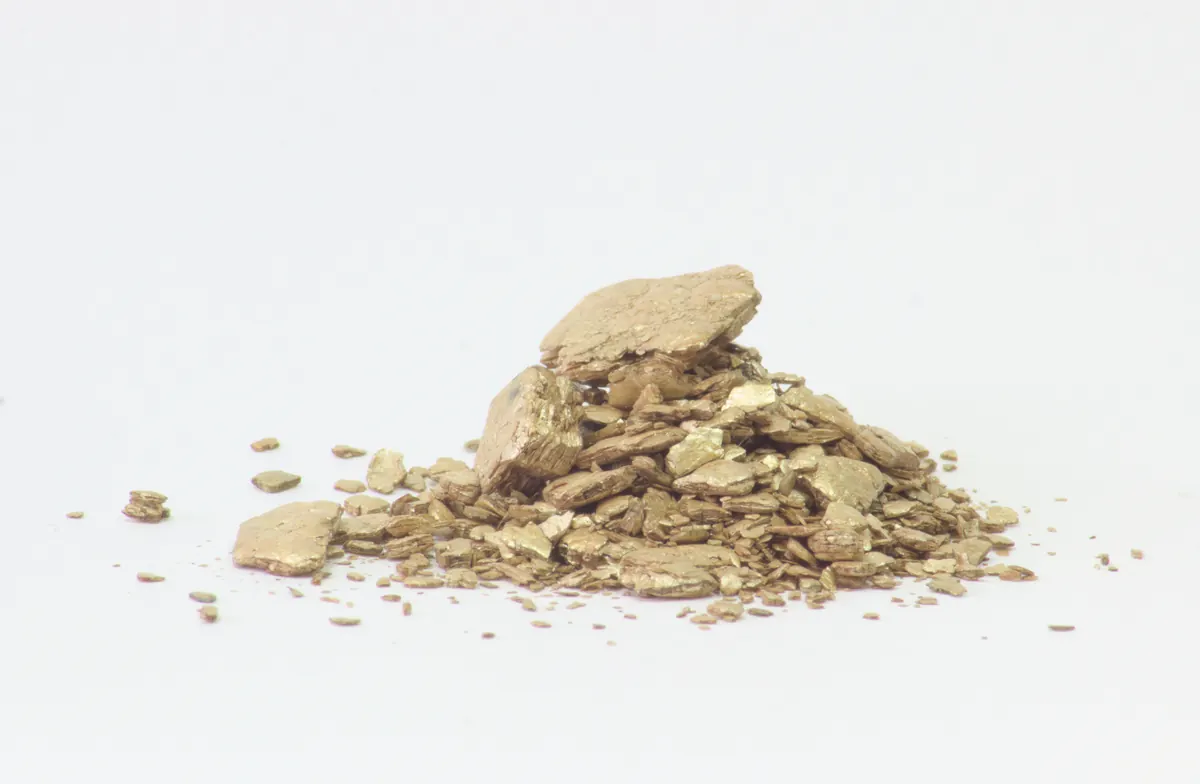
Most vermiculite sold in the United States came from a mine near Libby, Montana, and that mine was contaminated with asbestos. Much of it carried the brand name Zonolite. The EPA tells homeowners to assume their vermiculite contains asbestos, because you cannot tell by looking.
Do not sweep it, vacuum it, or move boxes through it. Do not take a sample. Disturbing it is what puts fibers in the air, and material sitting still in a closed attic mostly is not doing that. Testing and removal are a licensed trade of their own, and it is not the insulation trade. The vermiculite page covers what to do next, and it carries no quote form on purpose, because an insulation contractor is the wrong person to send you.
You may not need to identify it at all
Most people land on a page like this because they are planning to add depth. For that job the name of the old material barely matters. New insulation goes on top of old and the R-values add up. What decides the job is whether the old layer is dry, and how deep it already is.
So measure before you identify. The depth checker turns a ruler reading into an R-value range and compares it against your climate zone. If you come out within about R-10 of the level for your zone, which is this site's own estimate rather than a measured threshold, more depth is a slow payback whatever is under it, and the better buy is sealing the ceiling. We do not sell insulation and we do not install it, which is why this page can end a search instead of extending one.
Naming the material precisely changes exactly three decisions:
- Is it vermiculite? A different trade, and a health question rather than an energy one.
- Does it have to come out? Wet, moldy, rodent fouled, fire damaged, or packed to dust. The five-step test settles it.
- Is there foam at the roofline? That makes the attic part of your heated space, and the floor targets on this site stop applying.
Telling the two loose fills apart, which is the common confusion
Cellulose and blown fiberglass cover most attics between them, and people mix them up constantly. Three tells, in the order they are easiest to use.
Color. Cellulose is gray to gray-brown, because it is ground-up newspaper. Blown fiberglass is white, yellow or pink. In a dusty attic both go gray on the surface, so look where a joist has shaded the material or where a later layer covers an older one.
Texture. Cellulose looks like paper lint or shredded confetti. You can often see flecks of print in it. Fiberglass looks like spun fluff, and in the light it glints, because glass fiber does.
How it behaves. Cellulose is denser and holds a shape. It keeps a footprint or a handprint. Fiberglass is springier and partly recovers. Cellulose also settles more over the years, which is why an old cellulose attic often measures shallower than its invoice says.
Both are treated with fire retardant, usually borate for cellulose. Neither is a health hazard sitting in an attic, though both are irritating to breathe while disturbed, so a respirator belongs on your face before you handle either. The blown-in guide compares them properly, on settling, coverage and cost.
Batts, and the one thing the facing tells you
Figure 2
Faced batts, labeled the way the real thing is labeled
Kraft-faced fiberglass batts, with the R-value printed on the facing. Where the facing survives, it is the fastest identification on the page: it names the material and its rating in print.
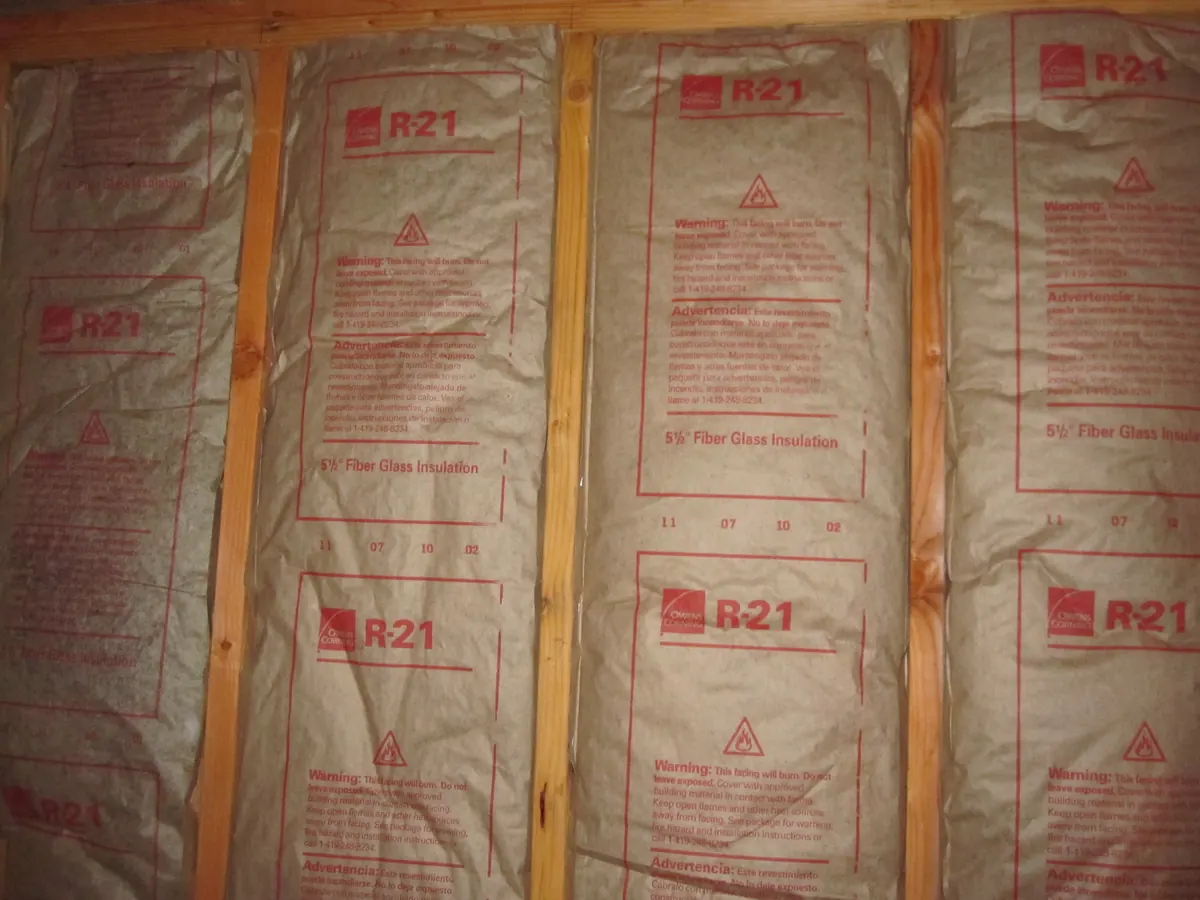
Batts sit between the joists in rectangles, with wood showing between the rows. If a paper or foil face survives, read it. The rating is printed there and it is the only place a batt's R-value actually appears.
That facing is also a vapor retarder, and it is the one real restriction on adding over. Two faced layers trap moisture between them. So a second layer of batts goes on unfaced, and it goes across the joists rather than along them, which covers the wood as well. The batt guide covers widths, facing and where batts beat loose fill.
The ones people mis-call
Mineral wool called fiberglass. Mineral wool is made from rock or from furnace slag, so it is heavier and stiffer. A batt of it stands on its own edge where a fiberglass batt flops over. The color runs gray-green to brown. It does not burn, and it holds its shape when wet far better than the alternatives.
Perlite called vermiculite. Both were poured in and both look like pebbles. Perlite is white to light gray and looks like tiny styrofoam beads. Vermiculite is gold-brown and looks layered, like a tiny accordion. Perlite carries no asbestos history. If you cannot tell which you have, treat it as vermiculite until somebody qualified says otherwise.
Radiant barrier called insulation. Foil stapled under the rafters is not depth and does not add to an R-value target. It reflects radiant heat instead of slowing heat through material, so it is measured as emittance rather than R. The radiant barrier page covers the narrow set of houses where it earns its price.
Foam at the roof called a spray foam attic floor. Where the foam is matters more than what it is. On the underside of the roof deck, it moves the insulated boundary to the roof and brings the attic inside the heated house. The floor is then meant to be bare, and an empty attic floor is not a missing job. Open cell against closed cell covers the two kinds.
Two layers, and reading an attic that has a history
Plenty of attics carry two layers, because they were insulated once and topped up later. That is normal, and it is not a defect. Read the top layer for what it is and the bottom layer for what it means.
The bottom layer is worth the second look for two reasons. It is older, so it is the one that could be vermiculite. And it is the one that has had decades to settle, get walked on, or take a roof leak. Push a ruler all the way to the drywall in three or four places rather than reading the surface.
An invoice does not settle it either. A 2003 receipt saying R-38 describes the day it went in. Twenty years of settling, a few trades walking through, and any water since then all subtract, and none of them left paperwork. Measure what is there. Insulating over existing insulation covers mixing materials, leveling and depth.
Common questions
How do I tell cellulose from blown fiberglass?
Color and texture, and you can see both from the hatch. Cellulose is gray or gray-brown, and it looks like shredded newspaper, because that is what it is. Blown fiberglass is white, yellow or pink, and it looks like fluff or cotton candy. There is a second tell if you are already up there. Cellulose lies denser and flatter, and it holds a footprint. Fiberglass springs back more. You do not need a sample and you should not take one.
What does vermiculite look like, and why does it matter?
Small pebbles about the size of a grain of rice, gray-brown to a silver-gold flake, layered and a bit glittery. It was poured in, so it lies flat between the joists instead of sitting up like a blanket. It matters because most vermiculite sold in the United States came from a mine near Libby, Montana that was contaminated with asbestos. The EPA tells homeowners to assume theirs has asbestos in it, leave it alone, and not take a sample. An insulation contractor is the wrong call for it.
Do I actually need to know what it is?
For most projects, no. If you are adding depth over material that is dry and undisturbed, the new layer goes on top and the R-values add up whatever is underneath. Depth and dryness are what decide that job. Naming the material exactly changes only three decisions: whether it might be vermiculite, whether it has to come out, and whether foam at the roofline has made your attic part of the heated house.
How can I tell mineral wool from fiberglass?
Mineral wool is heavier and stiffer. A batt of it stands up on its own edge, where a fiberglass batt flops. The color runs gray-green to brown rather than pink or yellow, and the fibers look coarser and shorter. Loose mineral wool is dense and granular rather than fluffy. It is also noticeably harder to compress with a hand.
There are two different layers up there. What does that mean?
It means the attic was insulated once and topped up later, which is common and normal. Read the top layer for what it is, and check the bottom layer for whether it is dry and whether it is vermiculite. The bottom layer is the one worth a second look, because it is older and because anything poured in before 1990 is the layer that could be vermiculite.
Should I take a sample to a lab?
Not for ordinary identification. You can name every common material by sight from the hatch. The one case where a lab is involved is suspected vermiculite, and even then the EPA says not to take the sample yourself, because disturbing it is what puts fibers in the air. That test belongs to a licensed asbestos professional, not to you and not to an insulation contractor.
Now that you know what it is
If the answer is add depth, licensed local contractors quote that work every day, and the pages above are how you check the quote before you accept it. If the answer was vermiculite, do not use this form. Use the vermiculite page instead.
Get quotes for the work
Tell us the job and your ZIP. We pass it to a licensed contractor who works in your area.
A marketing service, not a licensed contractor. Insulation work is performed by independent licensed local contractors.
- What does it cost?
- A 1,200 square foot attic blown to R-49 runs about $2,600 to $3,200 installed, from this site's own cost model dated August 2026. Two of its parts are estimates, so read it as a range and not a quote. See the full working and the price by attic size.
- What happens next?
- Your request goes to a licensed insulation contractor near you, usually within about an hour during the day.