
Attic insulation calculator
By Insulation Report Editorial. Last reviewed August 2026. How we research this.
In brief
How much attic insulation you need is simple math. Take the R-value your climate zone calls for, then subtract the R-value already on your attic floor. ENERGY STAR works from the 2021 IECC model code. It recommends a total of R-30 in zone 1, R-49 in zones 2 and 3, and R-60 in zones 4 through 8.
That last group covers most of the country. In blown fiberglass, R-60 from a bare deck is about 22 to 27 inches. In cellulose it is 16 to 19. If you already have 3 to 4 inches up there, you usually need about R-38 to R-49 added on top, not the whole amount.
Enter your ZIP, your attic size and what is up there now. The calculator gives you the target, the inches by material, and an installed cost range, and it names the source of every number. Loose fill settles, so treat any depth reading as an estimate.
Calculate yours
Where the square footage comes from
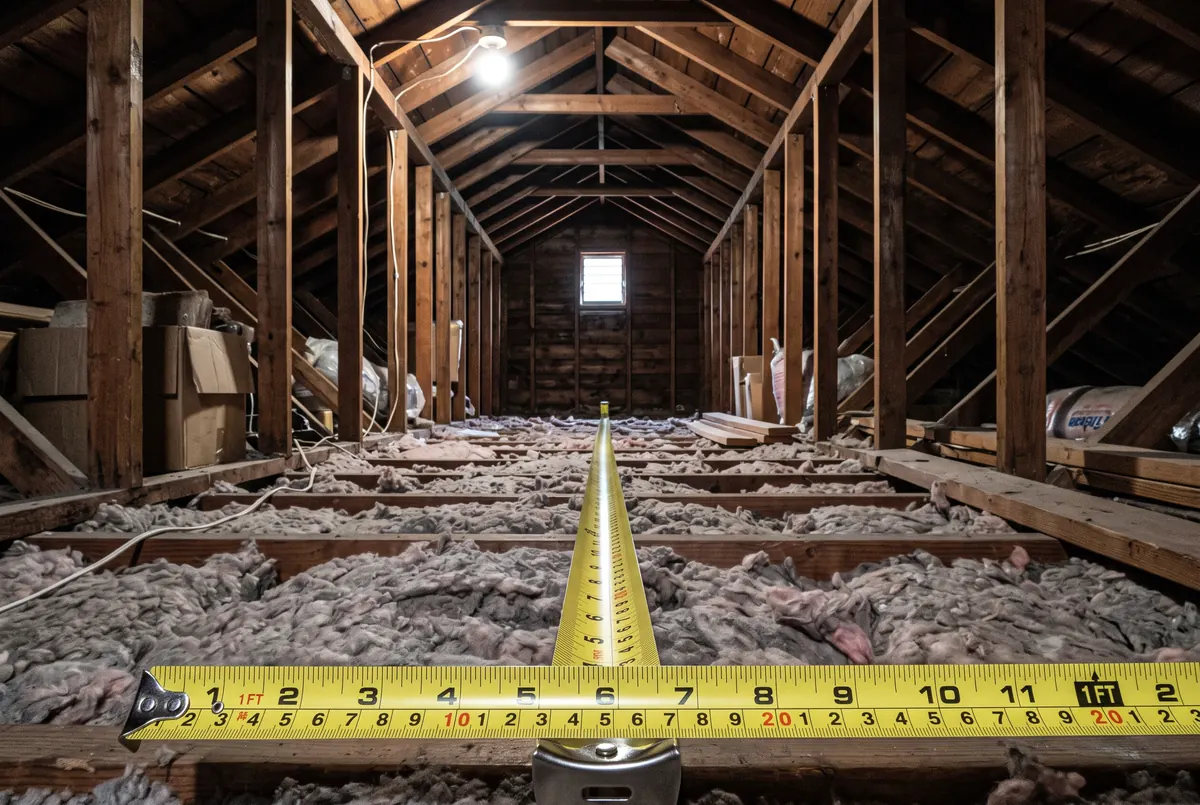
Floor area drives the bag count and every quote built on it. Measure the attic rather than assuming it matches the floor plan below, which it often does not.
Three things go in, and every number that comes out names its source. Your ZIP sets the climate zone, through the same lookup the climate zone by ZIP tool runs on its own page. It also picks the state whose Bureau of Labor Statistics wage prices the labor line. Want a different state, or the national average? Use the state selector to override it. Nothing you type here is stored. The result is built to be printed and checked line by line.
The recommended target, by climate zone
ENERGY STAR publishes a recommended attic level for each 2021 IECC climate zone. It gives a lower number if you already have 3 to 4 inches up there, because the first inches do the most work. Zone 1 is the southern tip of Florida, plus Hawaii. Zones 2 and 3 run across the Gulf coast, the south and most of California. Zones 4 through 8 cover everything from the mid-Atlantic and the Pacific Northwest up through Minnesota, Maine and Alaska.
| Climate zone | Uninsulated attic, total | Already has 3 to 4 in, add |
|---|---|---|
| Zone 1 | R-30 | R-25 |
| Zones 2 to 3 | R-49 | R-38 |
| Zones 4 to 8 | R-60 | R-49 |
These are recommendations for a home that already exists. They are not law. Energy codes cover new building and work under a permit. What each state has adopted varies a lot. Your local building department is the only authority on what a permit in your town needs.
What the target means in inches
R-value per inch is a range, not a single number. It changes with the product and with how densely the material went in. Loose fill also settles under its own weight. That is why the deeper targets need more than their share of extra material, and why measuring depth gives you an estimate of R-value rather than the real thing.
| Material | Inches for R-49 | Inches for R-60 |
|---|---|---|
| Blown-in fiberglass | 18.1" to 22.3" | 22.2" to 27.3" |
| Blown-in cellulose | 12.9" to 15.3" | 15.8" to 18.8" |
| Loose-fill mineral wool | 13.2" to 17.5" | 16.2" to 21.4" |
| Fiberglass batts | 12.9" to 16.9" | 15.8" to 20.7" |
| Mineral wool batts | 11.7" to 14.8" | 14.3" to 18.2" |
Bags, if you are doing it yourself
Coverage per bag drops as the target rises, and it drops faster than you would expect. Deep loose fill packs itself down. The R-49 and R-60 rows are the coverage the maker publishes for Owens Corning AttiCat blown-in fiberglass, 27.5 lb bag, read 2026-08-07. The R-38 row sits between two published points, worked out by the same R-times-coverage method the cost model uses. The label on the bag you actually buy is the one to trust.
| Target from a bare deck | Coverage per bag | Bags per 1,000 sq ft |
|---|---|---|
| R-38 | 53 sq ft | 19 |
| R-49 | 40 sq ft | 26 |
| R-60 | 32 sq ft | 32 |
Installed cost, from components
We built this table from parts you can check. We did not average other cost pages. There are four parts. The Bureau of Labor Statistics May 2025 average hourly wage for insulation workers (SOC 47-2131). A multiplier of 2.0 to 3.0 on that wage, covering payroll tax, insurance, equipment, overhead and profit. That one is an estimate, not a measurement. Crew time of 9 to 12 hours per 1,000 square feet, also an estimate. And material at the store price of $67.58 a bag.
A contractor pays less than store price for material, so the real low end sits below these numbers. This table uses a national wage. The calculator above swaps in your own state's BLS wage from your ZIP.
| Attic floor area | To R-38 | To R-49 | To R-60 |
|---|---|---|---|
| 1,000 sq ft | $1,750 to $2,250 | $2,200 to $2,650 | $2,600 to $3,050 |
| 1,200 sq ft | $2,100 to $2,650 | $2,600 to $3,200 | $3,100 to $3,700 |
| 1,500 sq ft | $2,650 to $3,350 | $3,300 to $4,000 | $3,900 to $4,600 |
| 2,000 sq ft | $3,500 to $4,450 | $4,350 to $5,300 | $5,200 to $6,150 |
Blown fiberglass, clean accessible attic, no removal, no air sealing, no baffles. Anything on that list moves the number, and the cost guide covers what each line adds. Removal of old material is its own job with its own price.
You may not need this
If your attic is within about R-10 of the recommendation, more depth is rarely the best use of the money. Insulation has strongly diminishing returns, and the last step from R-49 to R-60 saves a small fraction of what the first inches save. Air sealing the ceiling plane, meaning the gaps around light fittings, the plumbing stack, top plates and the hatch, usually beats it. We do not sell insulation and we do not install it, which is why this page can say so. Measure first with the depth checker, then decide.
When to bring in a contractor
Topping up an open attic you can walk in, with rented gear, is a real do-it-yourself job. Hiring makes more sense in a few cases. When the old material has to come out first, because it is wet, moldy, rodent fouled, or might be vermiculite. When headroom is tight or the framing is awkward. When the wiring is old. Or when air sealing and baffles need doing right first. And on a big gap across a whole attic, a contractor pays less for material and the machine time is already in the price, so the two routes often end up close.
Get quotes for attic insulation
If the calculator says you are short and you would rather not do it yourself, tell us the job and your ZIP. We pass it to a licensed contractor who works in your area.
A marketing service, not a licensed contractor. Insulation work is performed by independent licensed local contractors.
- What happens next?
- Your request goes to a licensed insulation contractor near you, usually within about an hour during the day.
Related
Common questions
How much insulation do I need in my attic?
The recommended total depends on your climate zone. ENERGY STAR works from the 2021 IECC model code. It recommends R-30 in zone 1, the far south. R-49 in zones 2 and 3. And R-60 in zones 4 through 8, which is most of the country. In blown fiberglass, R-60 from a bare deck is about 22 to 27 inches deep. In blown cellulose, about 16 to 19 inches. If your attic already holds 3 to 4 inches of old material, add one step less over the top. That is R-38 to R-49 in most zones.
How many bags of blown-in insulation do I need?
Take your attic floor area and divide it by the coverage printed on the bag for your target R-value. Round up. Coverage drops as the target goes up. The maker data we use lists about 69 square feet per bag at R-30, 40 at R-49 and 32 at R-60. That is because deeper loose fill packs itself down. Between the published rows, our model fills in the gap. The label on the exact bag you buy is the one to trust. And buying one bag more than the math says is cheaper than driving back to the store.
How much does attic insulation cost installed?
For blown fiberglass to R-49, the model on this page comes out around $2.18 to $2.66 a square foot installed. Material at store price is most of that. So a 1,200 square foot attic taken to R-49 lands near $2,600 to $3,200. The labor side starts with the Bureau of Labor Statistics May 2025 average wage for insulation workers. Then it multiplies that by a figure covering what a worker costs beyond wages. That multiplier is an estimate, and the page says so every time it shows up.
Why does the calculator ask for my ZIP code?
For two lookups, and both happen right here in your browser. The first is your climate zone. We match the ZIP to its county using a Census Bureau file, then match the county to its 2021 IECC zone using Department of Energy and Pacific Northwest National Laboratory data. The second is the labor line. The first three digits of a ZIP tell us your state, through the USPS prefix list. So the cost estimate uses your own state's Bureau of Labor Statistics May 2025 average wage for insulation workers instead of the national one. About 3 percent of ZIPs sit across a zone line, and the result says so when yours does. We do not store the ZIP you type here. This is not a lead form.
Should the old insulation come out first?
Usually not. Dry, clean material stays where it is and the new depth goes over the top, which is the cheaper and normal path. It has to come out when it is wet, moldy or rodent contaminated, or when it might be vermiculite, which is a separate licensed trade. The remove-or-add-over guide on this site walks that decision step by step before you spend anything.
Is more insulation always worth it?
No. Insulation has strongly diminishing returns: the first inches do most of the work, and going from R-38 to R-60 saves far less per year than going from R-10 to R-38. If you are within about R-10 of your zone recommendation, air sealing the ceiling plane, the gaps around lights, plumbing and the hatch, is usually the better spend. That is also why an attic already near target rarely justifies a contractor visit.