
How much insulation do I have?
By Insulation Report Editorial. Last reviewed August 2026. How we research this.
In brief
Measure how deep the insulation is on your attic floor, in inches. Then multiply by the R-value per inch of that material. Blown fiberglass runs about R-2.2 to R-2.7 an inch. Cellulose runs about R-3.2 to R-3.8. Fiberglass batts run about R-2.9 to R-3.8. So ten inches of blown fiberglass is roughly R-22 to R-27.
Now compare that with what your climate zone calls for. ENERGY STAR puts it at R-30 in the far south, and R-49 to R-60 across most of the country. If you can still see the joists above the insulation, you have under about 10 inches. That is short almost everywhere.
The normal fix is to add new material over the top. The old stuff only has to come out if it is wet, moldy, rodent fouled, or might be vermiculite. Treat any depth reading as an estimate. Loose fill settles, and its R-value does not climb in step with depth.
Check your own attic
How the measurement is actually taken
Push the ruler down until it stops on the drywall. Read it at the surface. Do that in at least five spots, and use a typical reading, not the deepest one.
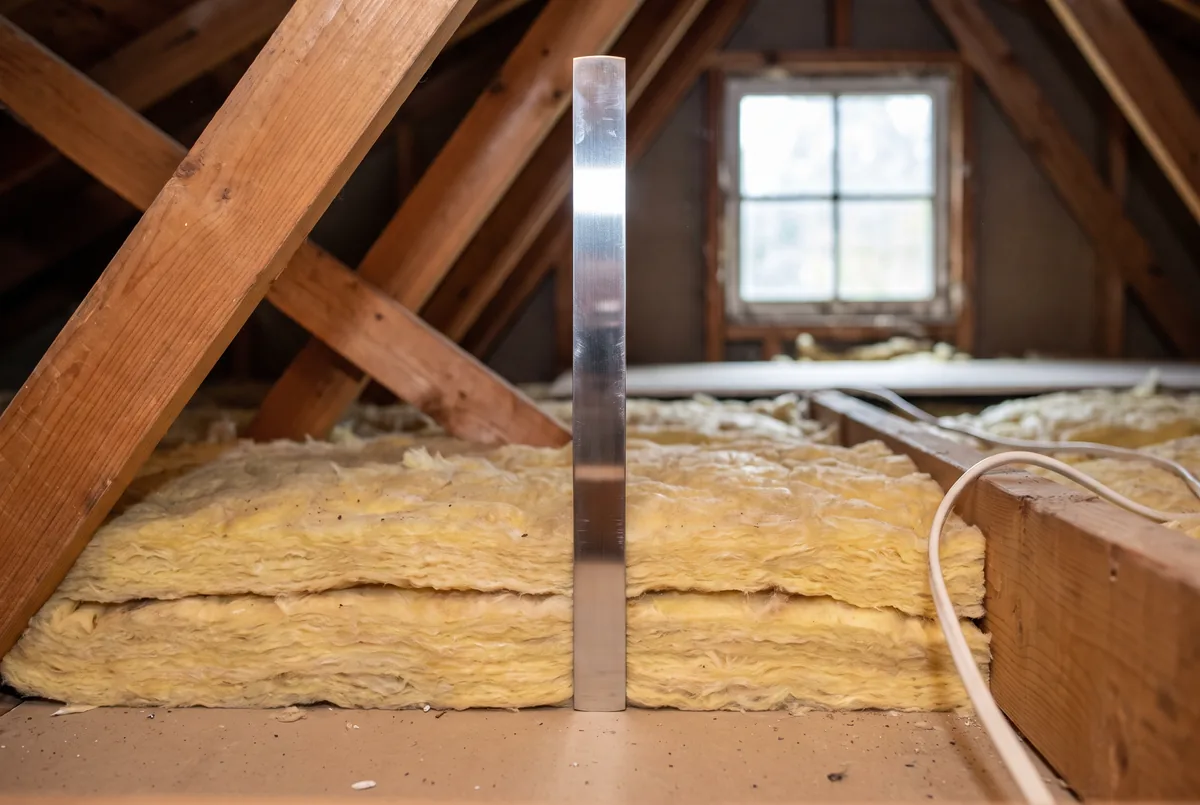
Enter what you measured. The result is a range rather than a single number, because R-value per inch genuinely varies with product and installed density, and a single number would be false precision. The ZIP is optional and is used only to look up your climate zone, which the climate zone by ZIP lookup can also find on its own.
Depth to R-value, by material
The same arithmetic in table form. Read down to your measured depth and across to your material. Ranges are given because R per inch varies by product and by how densely the material was installed.
| Measured depth | Blown-in fiberglass | Blown-in cellulose | Loose-fill mineral wool | Fiberglass batts | Mineral wool batts |
|---|---|---|---|---|---|
| 3 inches | R-6 to R-8 | R-9 to R-11 | R-8 to R-11 | R-8 to R-11 | R-9 to R-12 |
| 4 inches | R-8 to R-10 | R-12 to R-15 | R-11 to R-14 | R-11 to R-15 | R-13 to R-16 |
| 5 inches | R-11 to R-13 | R-16 to R-19 | R-14 to R-18 | R-14 to R-19 | R-16 to R-21 |
| 6 inches | R-13 to R-16 | R-19 to R-22 | R-16 to R-22 | R-17 to R-22 | R-19 to R-25 |
| 7 inches | R-15 to R-18 | R-22 to R-26 | R-19 to R-25 | R-20 to R-26 | R-23 to R-29 |
| 8 inches | R-17 to R-21 | R-25 to R-30 | R-22 to R-29 | R-23 to R-30 | R-26 to R-33 |
| 10 inches | R-22 to R-27 | R-32 to R-38 | R-28 to R-37 | R-29 to R-38 | R-33 to R-42 |
| 12 inches | R-26 to R-32 | R-38 to R-45 | R-33 to R-44 | R-34 to R-45 | R-39 to R-50 |
| 14 inches | R-30 to R-37 | R-44 to R-53 | R-39 to R-51 | R-40 to R-53 | R-46 to R-58 |
| 16 inches | R-35 to R-43 | R-51 to R-60 | R-44 to R-59 | R-46 to R-60 | R-52 to R-67 |
| 18 inches | R-39 to R-48 | R-57 to R-68 | R-50 to R-66 | R-52 to R-68 | R-59 to R-75 |
| 20 inches | R-44 to R-54 | R-64 to R-76 | R-56 to R-74 | R-58 to R-76 | R-66 to R-84 |
R-value per inch comes from published material data. We carry it as ranges in
src/data/r-values.ts, with sources noted in our reference data. Spray foams are
not in this table. A contractor sprays them to a set thickness, so a homeowner is not
measuring them after the fact. And closed-cell foam, at R-6 to R-7 an inch, is a different
calculation altogether.
What the number should be
ENERGY STAR publishes a recommended attic level for each climate zone. It says that advice is based on the 2021 International Energy Conservation Code. If your attic already has three to four inches, the recommendation drops one step below the bare-attic number. That is why the table below carries both.
| Climate zone | Uninsulated attic | Already has 3 to 4 inches | Roughly where |
|---|---|---|---|
| Zone 1 | R-30 | R-25 | Southern tip of Florida, Hawaii |
| Zones 2 and 3 | R-49 | R-38 | The Gulf coast, the south, southern California |
| Zones 4 to 8 | R-60 | R-49 | Most of the country, from the mid-Atlantic north |
The joist trick, if you have no ruler
Read the depth against the framing, not against your eye
The joist is a ruler you already own, and its actual depth is standardized. Anything that buries it is deeper than the framing; anything that does not is shallower.
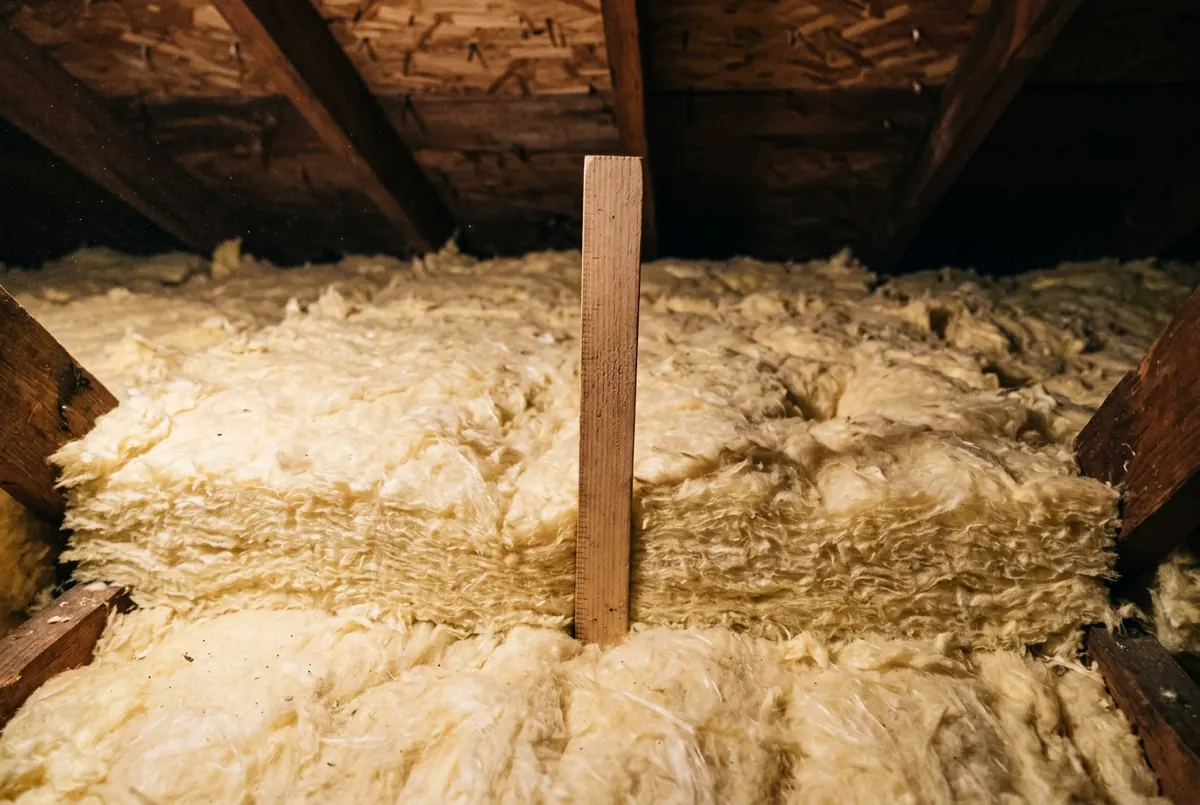
Look across the attic floor. If you can see the tops of the ceiling joists standing proud of the insulation, you have less than the depth of a joist. A standard ceiling joist is 2x6, 2x8 or 2x10 nominal, which is 5.5, 7.25 or 9.25 inches actual. So visible joists mean under about 9 inches in the deepest common case, which is roughly R-20 to R-24 in fiberglass and short of the recommendation in every climate zone in the country.
If the insulation is level with the joist tops you are at joist depth. If it is well above them and you cannot see them at all, you are likely at 12 inches or more and worth measuring properly before spending anything.
You may not need to do anything
This is the section most pages on this subject leave out, and it is the honest answer for a real share of people who measure their attic.
- You are within about R-10 of the recommendation. The savings from closing a small gap are real but slow, and the payback on the last few inches is much longer than on the first few. Insulation has strongly diminishing returns: going from R-11 to R-30 saves far more than going from R-38 to R-49.
- You have air leaks you have not dealt with. Sealing the ceiling first is almost always the better buy. Insulation slows heat moving through solid material. It does nothing about air pouring through gaps around light fixtures, plumbing pipes, the attic hatch and the tops of walls. Lay insulation over an unsealed ceiling and it will not hit the number on its label. Sometimes it will miss by a lot.
- You are about to redo the roof, the wiring or the vents. Insulating right before work that will tear it up wastes the money twice.
- Your attic is heated and cooled, or has spray foam up at the roof. Then the depth on the floor is not the number that matters, and this tool does not apply.
We do not sell insulation and we do not install it. That is why we can say that. If your measurement lands close to the recommendation, the next useful step is usually an air sealing check, not more depth.
When the answer is to hire someone
Adding loose fill over an attic you can walk around in is a real do-it-yourself job. You can rent the blowing machine. Hiring is the honest answer in these cases. The old material is wet, moldy or rodent fouled and has to come out first. The material is, or might be, vermiculite, which is a licensed trade of its own. Headroom is tight, or the space is a knee wall, a cathedral ceiling or a bonus room. The wiring is old. The soffit vents need baffles before anything goes near the eaves. Or the ceiling needs proper air sealing first.
If you are short by more than about 20 R-values across the whole attic, the sheer amount of material usually brings a contractor within reach of the rental price. They pay less than store price for material, and the machine time is already in their number. The attic insulation calculator turns the gap you measured into bags and an installed cost range.
Get quotes for adding attic insulation
If your measurement came up short and you would rather not do it yourself, tell us the job and your ZIP. We pass it to a licensed contractor who works in your area.
A marketing service, not a licensed contractor. Insulation work is performed by independent licensed local contractors.
- What does it cost?
- A 1,200 square foot attic blown to R-49 runs about $2,600 to $3,200 installed, from this site's own cost model dated August 2026. Two of its parts are estimates, so read it as a range and not a quote. See the full working and the price by attic size.
- What happens next?
- Your request goes to a licensed insulation contractor near you, usually within about an hour during the day.
Related
Common questions
How do I measure the depth of my attic insulation?
Push a ruler or a marked stick straight down through the insulation until it hits the ceiling drywall. Then read the depth at the top of the material. Do this in at least five spots, away from the hatch and away from the eaves. Insulation settles unevenly, and the area by the hatch is usually the most trampled. Use a typical reading, not the deepest one. If you can see the joists sticking up above the insulation, you are almost certainly short. A standard joist is a 2x6 to a 2x10, which is only 5.5 to 9.25 inches deep.
Is 6 inches of attic insulation enough?
Almost certainly not, anywhere in the United States. Six inches of blown fiberglass is roughly R-13 to R-16, and six inches of cellulose about R-19 to R-22. The lowest number on the ENERGY STAR chart is R-25, for a zone 1 attic that already has three to four inches. A bare zone 1 attic is R-30. Zone 1 is the southern tip of Florida and Hawaii. Most of the country is recommended R-49 to R-60. Six inches is typical of houses built before the 1980s that have never been topped up.
Can I just add new insulation over the old?
Usually yes, and it is the normal way to do this. Old insulation that is dry, clean and free of rodent or mold damage can stay. New loose fill goes straight over the top. Unfaced batts can be laid across the joists at right angles. There is one exception, and it matters. Never lay faced batts on top of old insulation with the paper or foil facing down. That traps water between the layers. Tear the facing off, or buy unfaced material.
Does my R-value drop as the insulation gets older?
Loose fill settles. That cuts the depth, and so it cuts the total R-value. Most of that settling happens in the first few years. After that, insulation that stays dry and undisturbed does not really lose R-value with age. Three things do wreck it. Water. Being squashed by stored boxes or a walked-on floor. And getting shoved around by anyone working up there. Insulation that got wet and dried out is usually still ruined, because the fibers mat together and never fluff back up.
Why does this tool give me a range instead of one number?
Because R-value per inch genuinely varies. Blown fiberglass runs about R-2.2 to R-2.7 an inch depending on the product and its installed density, and cellulose about R-3.2 to R-3.8. A tool that reports a single number is reporting a precision that does not exist. The range brackets the honest answer, and where the decision is the same at both ends of the range, which it usually is, the range is all you need.
Does a radiant barrier count toward my R-value?
No. A radiant barrier reflects radiant heat rather than resisting conduction, so it has no useful R-value per inch and cannot be added to an R-value target the way bulk insulation can. The two are measured differently and do not add together. A radiant barrier can reduce summer heat gain in a hot, sunny climate, but it is not a substitute for depth and it should never be counted as one.