
Ice dams: the fix is on the ceiling below, not the roof above
By Insulation Report Editorial. Last reviewed August 2026. How we research this.
In brief
An ice dam is a heat-loss symptom, and the lasting fix is on the ceiling below it, not the roof above it. Warm air escaping into the attic warms the roof deck, snow melts over the warmed area, and the meltwater refreezes when it reaches the overhang at the eave, which stays cold because there is no heated space beneath it.
The ridge that forms ponds water behind it and pushes it under the shingles. Today, rake the snow off the lower roof from the ground, and do not chip the ice or climb up after it.
Permanently, air seal the attic floor, then insulate to your climate zone target, roughly $2,622 to $3,190 installed on a 1,200 square foot attic as an estimate built from stated inputs below. Heat cable manages the symptom at ongoing electricity cost. More ventilation is the third lever, not the first.
If water is coming in today
Triage buys days, not a fix. In order, with the two prohibitions up front because they are the expensive mistakes:
- Do not chip, pry or hammer the ice off. Mechanical removal takes the shingle surface with it. The UMass article's inventory of what people reach for, hammers, ice picks, crow bars, even chain saws, comes with the observation that more damage is done to life, limb and roof in the process than the dam was doing.
- Do not go up on the roof. The Minnesota Extension warning is direct: anyone on a winter roof risks injury and may damage the roof and house, and the job belongs to professionals with the equipment for it.
- Rake the snow off the lower roof, from the ground. A telescoping roof rake removes one of the ingredients the dam needs. No snow above the eave means no new meltwater feeding the pond. Raking can still scuff shingles, so keep the blade off the surface where the rake's design allows it.
- Open a drainage channel if water is actively coming in. The Minnesota method is hosing with tap water on a warm day, working upward from the lower edge of the dam, so the pond behind it can drain. It is explicitly temporary: the extension calls a channel ineffective within days. Its job is to empty the pond, not to remove the ice.
- Inside, move what the water can ruin and let things dry before repairing anything. One rule from the Minnesota guidance for after the leak: do not repair interior damage until the ceilings and walls have dried out. Paint and patches over damp plaster fail, and a moisture meter on the framing settles when dry actually arrives.
- Book the real work for spring. Air sealing and insulation are attic jobs that do not care what season the roof is having, and spring is when crews are quotable. The guides hub puts the whole sequence of attic work in order.
Professional ice dam removal
If the ice has to come off before spring, the Minnesota Extension's answer is to hire it out. Its warning covers work on the roof and work on it from below, and it says the job belongs to professionals. The extension describes only the two removal methods above, raking off the snow and hosing temporary channels, so this page will not name others. Whoever you call, removal is triage on the same tier as the rake: it clears today's ice while the heat loss that built it keeps running, so the dam comes back until the ceiling is fixed. For that fix, the same extension points to weatherization contractors as the professionals who deal with the heat transfer problem that creates ice dams, which is the spring work in the ranked list below.
When an ice dam is worth worrying about
Not every dam is an emergency. The dam itself sits harmlessly on the eave until water ponds behind it. Shingles shed water running downhill; they are not a barrier against standing water pushed uphill, so a deep enough pond finds the joints, then the deck, then the eave framing, then the top of the exterior wall. By the time it shows indoors it has usually been traveling for a while.
- Ceiling stains along the exterior wall, in the first foot or two of the room, are the classic signature: that is the plaster directly below the eave.
- Water running down inside a wall shows as peeling paint, swollen trim or a damp patch at the top of the wall, sometimes a room away from the leak point.
- Wet insulation above the eave is the quiet cost. Soaked loose fill compacts and loses R-value, which makes the cold edge of the ceiling colder and next year's dam easier to start. The symptom guide covers what water does to the material, and persistent wetting ends at mold in the insulation.
- A thick ice ridge with no water indoors still merits the spring fix, but it is not an emergency. Icicles alone are not proof of a dam.
Why the dam forms at the coldest edge of the roof
With the triage handled, here is what is building the ridge. The University of Minnesota Extension states the condition precisely: an ice dam needs three things at the same time.
- snow on the roof,
- an upper roof deck above 32 F, and
- an eave below freezing.
Figure 1
The ridge at the eave, and the icicles that advertise it
Snow is melting over the heated part of this roof and refreezing where the overhang stays cold. The ice band at the gutter line is the dam; the water it ponds is above it, out of sight.
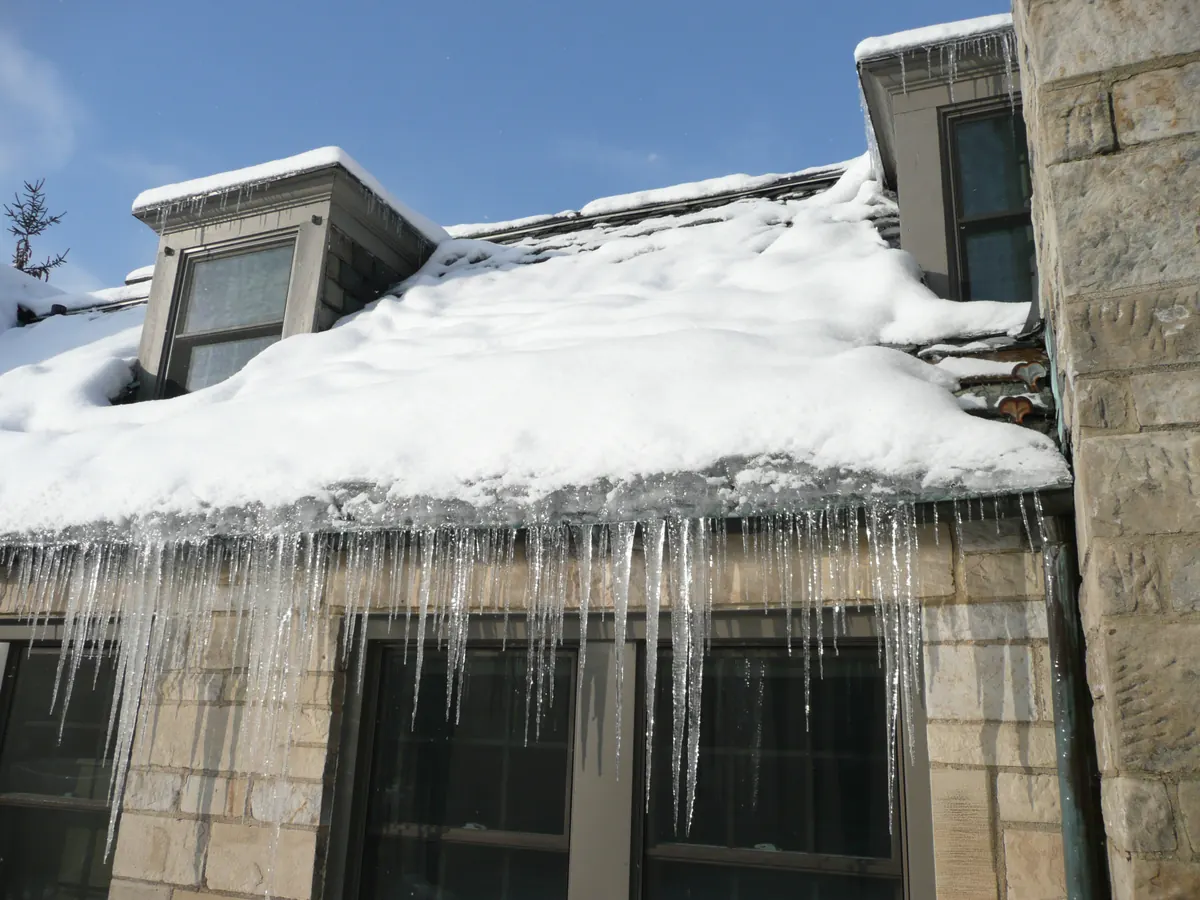
Snow on the warm part melts, the water runs downslope, and where it crosses onto the part of the roof that is below freezing it stops being water.
The line between those two surfaces is drawn by your ceiling. Over the heated rooms, warm indoor air leaking through the ceiling plane, plus conduction through thin insulation, warms the underside of the deck. Past the exterior wall, the overhang at the eave has nothing under it but outdoor air, so it holds outdoor temperature. Melt above, refreeze at the eave, and the ridge of ice grows with every cycle.
Snow itself is an insulator
Snow makes the melt worse, because it insulates: roughly R-0.5 to R-1 per inch by the approximate figure in the UMass Amherst Building and Construction Technology article on ice dams. A fresh blanket of it traps the escaping heat against the deck instead of letting it vent away. That is how the same source reports dams forming with as little as 1 to 2 inches of snow on a leaky roof. The deeper the snow, the better insulated the melt zone gets.
Most of that heat arrives on moving air, not through the material. Warm air rises. In winter your house acts like a chimney, and the ceiling is where it pushes out. That is the stack effect, worked through on the air sealing guide. It is why the cure is sealing first and depth second, and why depth alone underdelivers over a leaky ceiling. The same escaping air, in a colder snap, shows up inside the attic as frost on the sheathing and nail tips. Frost inside and a dam outside are one symptom read from two sides of the deck.
Every fix, ranked
The market sells all of these as ice dam solutions. They are not equivalents, because only two of them touch the heat loss that draws the melt line. Costs below state their basis; the two retail prices are single listings read in August 2026 standing in for their product class, so treat both as estimates.
| Fix | What it actually does | Cost | Verdict |
|---|---|---|---|
| Air seal the ceiling plane | Removes the heat source. The dam is built by warm air reaching the deck; sealing stops it leaving the house | Materials are caulk, foam and board; the job is priced in crew hours. The air sealing guide builds the billed-hour bracket | The cure. First, always |
| Insulate to the zone target | Slows the conducted share of the heat once the airborne share is stopped | About $2,622 to $3,190 installed to R-49 on 1,200 sq ft. Insulation Report Cost Model estimate; method below | The other half of the cure. After sealing, never instead of it |
| Roof ventilation | Flushes the attic with outdoor air so the deck stays near outdoor temperature | Not priced here. The ventilation hub covers the system | Third lever. Finishes the job the first two did; cannot rescue a leaky ceiling |
| Roof rake | Removes the fuel. No snow above the eave, no meltwater | $77.48 for a 17 ft telescoping rake at one national retailer, read August 2026. Estimate for the class | Triage. Works every storm, prevents nothing |
| Melt channels | Drains the pond behind the dam today | A hose, tap water and a warm day | Triage. Ineffective within days, per the Minnesota Extension |
| Heat cable | Melts drainage paths through the eave ice whenever it is powered | $94.98 for a 100 ft kit at one national retailer, read August 2026, estimate for the class. Then electricity: the manufacturer spec is 5 watts per foot at 120V, so that kit draws about 500 watts while on | Last resort. Manages the symptom at ongoing cost |
| Chipping, prying, hammering | Takes shingle surface with the ice, and people off roofs | Free until the roofing bill | Never |
The verdict, in one line: rake this winter, seal and insulate before the next one, and reach for cable only if the cure genuinely cannot be applied to your roof. The ranking is not this site's invention. The Department of Energy's Building America Solution Center orders ice dam prevention exactly this way, air seal the ceiling plane, insulate the attic, ventilate the roof, and calls sealing the air leaks the most important step.
Two notes on the ventilation row. Venting gets sold as the ice dam fix because you can see it on the roof, where the problem looks like it lives. What it actually does is water the heat down. Air moving from soffit to ridge carries attic heat out, so the deck stays near outdoor temperature. That works when only a little heat is arriving. It gets overwhelmed when a leaky ceiling delivers warm air faster than the vents can remove it. One venting detail belongs in an ice dam project no matter what: baffles at the eaves, so new depth cannot block the soffit intakes. A blown attic that seals off its own eave path just trades one moisture problem for another.
Where the insulation number comes from
The bracket in the table is built from parts, not averaged from other cost pages, and it contains estimated inputs:
- Attic floor area 1,200 sq ft, target R-49.
- Labor: 10.8 to 14.4 crew-hours at $26.32/hr (BLS national mean; no state given), times a 2 to 3 burden multiplier covering payroll tax, insurance, equipment, overhead and profit.
- Material: 30.4 bags at $67.58 (39.5 sq ft per bag at R-49), at retail shelf price.
- Wage data May 2025. Material price read 2026-08-07.
- The burden multiplier and the crew-hour range are estimates, not measurements. Material is shown at retail; a contractor pays less.
Per square foot, that is about $2.18 to $2.66 installed. Air sealing is deliberately not folded into the number: it is priced in hours, and the air sealing guide shows how to read that part of a bid. Ask for the two as separate line items in one visit.
What your zone actually asks for
Ice dam country is mostly 2021 IECC climate zones 4 through 8, and ENERGY STAR's recommended attic levels for those zones are the highest on its table. The retrofit column matters: an attic that already has 3 to 4 inches gets a lower top-up target than a bare one.
| 2021 IECC zone | Uninsulated attic | Existing 3 to 4 inches |
|---|---|---|
| Zone 1 | R-30 | R-25 |
| Zones 2 and 3 | R-49 | R-38 |
| Zones 4 through 8 | R-60 | R-49 |
The climate zone lookup turns your ZIP into a zone. The R-value hub explains what the targets mean and where they come from. If there is already material up there, the usual answer is to seal and add over the top, not to start again. Insulating over existing insulation walks that decision. In cold climates the common path is blown fiberglass or cellulose over the old layer.
You may not need any of this
Three honest cases. We do not sell insulation and we do not install it, which is why this page can tell you when the answer is a rake or nothing at all.
- A steep metal roof that sheds its snow. The dam needs snow sitting on the roof; that is the first condition in every source above. A roof that dumps its load after each storm rarely holds the ingredient long enough to dam, and a rake covers the odd stubborn patch.
- A newer, tested-tight house with full-depth insulation. If the ceiling was air sealed at construction, the attic meets its zone target, and dams have not appeared in past winters, an extreme storm that produces one small ridge is weather, not a defect. A rake year to year may be the entire program.
- A one-off after an unusual storm. One dam in a decade, no interior water, gone with the thaw: watch it, rake next time, and spend nothing yet. Annual dams, or any water indoors, put you back in the table above.
And one product warning in the same spirit: heat cable is routinely marketed as ice dam prevention. It is not prevention. It is symptom management with a power cord, defensible as a last resort on a roof whose ceiling genuinely cannot be fixed, and a poor substitute for a few hundred dollars of sealing on every other roof.
Get the ceiling fixed before next winter
Tell us the job and your ZIP. We pass it to a licensed contractor in your area who can quote air sealing and insulation as separate line items in one visit.
A marketing service, not a licensed contractor. Insulation work is performed by independent licensed local contractors.
- What happens next?
- Your request goes to a licensed insulation contractor near you, usually within about an hour during the day.
If you buy anything this winter
Both items here manage a symptom. The dam itself is heat escaping through the ceiling, and neither of these touches that. Buy them for the winter you are already in, and put the real money into air sealing and depth before the next one.
Insulation Report earns a commission if you buy through some of the product links on this page. It costs you nothing extra and it does not change which products we recommend or what we say about them.
-
Look for A telescoping handle in the 17 to 21 foot range, with a poly blade or rollers that keep the edge off the shingle surface.
Pulls the snow, which is the fuel, off the lower few feet of roof from the ground. No snow above the eave, no meltwater to refreeze there.
Skip it if You cannot reach the eaves from flat ground. A rake used from a ladder trades a wet ceiling for a fall, and winter roof work is a job for a professional.
-
Roof and gutter de-icing cable
Look for A UL-listed kit with shingle clips, sized to the eave run. Manufacturer spec for the common kits is 5 watts per foot at 120 volts, so length sets the draw.
Melts drainage channels through the ice at the eave so ponded water can get off the roof. It manages the symptom while it is powered; it does not stop the dam forming.
Skip it if You have not priced air sealing yet. The cable is the last resort after the ceiling is fixed, not an alternative to fixing it.
Common questions
Do heat cables prevent ice dams?
No. A heat cable melts channels through the ice near the eave, so pooled water can drain off the roof. That manages the symptom, and only while the cable is switched on. One major maker specifies 5 watts per foot at 120 volts across its kit lengths. So a 100 foot run draws about 500 watts the whole time it is running. And the dam keeps building around the melted paths, because nothing has touched the heat loss creating it. The UMass Amherst building science article on ice dams goes further. It reports shingles made brittle and a fire risk. Its author says he has never seen a zig-zag cable layout fix an ice dam problem. Treat cable as a retreat for a roof you cannot fix properly this winter, not as prevention.
Can I just rake the roof every winter instead of fixing the attic?
You can, and on some houses it is a defensible strategy. Raking the lower few feet of roof after each storm removes the fuel, so no meltwater reaches the cold eave to refreeze. The costs are the effort after every snowfall, the chance of scuffing the protective mineral surface off the shingles, and the fact that the heat loss building the dams keeps running through your energy bill all winter whether or not a dam forms. If your attic is already sealed and insulated to target and dams are rare, a rake year to year is a reasonable answer. If dams are an annual event, the ceiling below is telling you where the money should go.
How much snow does it take to form an ice dam?
Less than most people expect. The UMass Amherst article reports dams forming with as little as 1 to 2 inches of snow on a leaky roof. Snow is itself an insulator, at roughly R-0.5 to R-1 an inch by that source’s rough figure. So a blanket of snow traps escaping house heat against the roof deck. The deck climbs above freezing underneath it, and melting starts even in cold weather. That is why a house with a leaky ceiling grows a dam from a modest storm while the house next door stays clear. The difference is the heat arriving under the snow, not the snow.
Will more roof vents fix my ice dams?
Venting is the third step, not the first. The Department of Energy’s Building America Solution Center spells out the order. Seal the ceiling. Insulate the attic well. Then vent the roof. It calls sealing the air leaks the most important step. Venting keeps the deck near outdoor temperature by flushing the attic with outside air. That only works once you have cut off the supply of warm indoor air from below. The University of Minnesota Extension adds that once sealing and insulation are done well, you need only a small amount of roof venting. A contractor whose whole ice dam plan is more vents has skipped steps one and two.
Should I chip the ice off, or knock the icicles down?
No to chipping. Hammers, ice picks, crow bars and shovels take roof surface off along with the ice. The UMass Amherst article puts that high on its list of ways people hurt themselves and wreck a roof. The University of Minnesota Extension is blunter about going up there at all in winter. It warns that anyone on the roof in winter risks injury and may damage the roof and house, and that the work belongs to professionals. Icicles at the eave are the same refreeze mechanism in miniature and are not by themselves proof of a dam, but a thick ridge of ice at the roof edge with water backed up behind it is.
What does the permanent fix cost?
Two parts. Air sealing is priced in crew hours, not square feet. The number of holes in the ceiling sets the time. Our air sealing guide builds a billed crew hour from the BLS trade wage and a stated multiplier, so you can check the shape of a bid. New blown insulation to R-49 on a 1,200 square foot attic comes to roughly $2,622 to $3,190 installed in our model. That model uses the BLS wage, an estimated crew-hour range, an estimated wage multiplier and a dated store material price. Treat it as a bracket, not a quote. And get the sealing itemized in the same visit.