
Blown-in insulation cost, per square foot and per bag
By Insulation Report Editorial. Last reviewed August 2026. How we research this.
In brief
Blown-in attic insulation is quoted three ways, and they are the same number wearing different clothes. Per square foot of attic floor, the model on this page puts fiberglass at $2.18 to $2.66 installed at R-49 and $2.60 to $3.07 at R-60.
Per bag, the same job is $86 to $105 at R-49, because one bag of the anchor product covers 39.5 square feet at that target. Material alone, at retail shelf price, is $1.71 per square foot at R-49, which is most of the total.
Convert between them with one identity: installed price per bag equals installed price per square foot times the square feet one bag covers at your target R-value. Coverage falls as the target rises, so a per-bag price is meaningless until the R-value is stated. Two inputs behind these figures, the burden multiplier and the crew hours, are estimates rather than measurements.
The three ways this job gets quoted
Where the bag count becomes a cost
Material is bought and priced by the bag. Everything else in a blown-in quote is time, travel and setup, which is why the two lines move independently.
The attic insulation cost hub builds the installed total by attic size and target. It names the four inputs behind it, and gives you a test for whether a quote is fair. For one size worked end to end, see the cost to insulate a 2,000 square foot attic. This page works one level down, at the unit. What a bag covers. What a bag costs. And how a price given in any one of the three common units converts into the other two.
Contractors and retailers do not agree on a unit. A bid arrives as a flat project price. A supplier prices by the bag. Cost content quotes dollars per square foot. All three describe the same job, and two pieces of arithmetic move between them.
| Quoted as | What it is measuring | To get dollars per square foot |
|---|---|---|
| Per square foot | Attic floor area, which is roughly the footprint of the heated space below, not the roof area | Already there. Check which area the contractor measured |
| Per bag installed | One package of loose fiber, delivered and blown | Divide by the square feet one bag covers at the target R-value |
| Flat project price | Everything in the written scope, which may or may not include air sealing, baffles and disposal | Divide by the attic floor area in the scope |
The version worth remembering runs the other way, because it is the one that catches a bad comparison. Installed price per bag equals installed price per square foot, times the coverage of one bag at that R-value. Coverage is published for the product, so you can check both sides.
The conversion, worked
Take a 1,200 square foot attic blown to R-49, and a flat quote of $2,900, which is the middle of the band this site's model produces for that job. Working through the three units:
- Flat to per square foot. $2,900 divided by 1,200 square feet is $2.42 per square foot.
- Per square foot to bags. One bag of the anchor product covers 39.5 square feet at R-49, so the job is 1,200 divided by 39.5, about 30 bags, or 31 bought whole.
- Per square foot to per bag installed. $2.42 times 39.5 square feet is about $96 a bag installed, of which $67.58 is the retail material.
That last line is the useful one. It splits a quote in two: the part you can check at a store today, and the part you are paying the contractor for. You do not need the contractor to itemize anything to do it. It also shows the trap in per-bag pricing. A bag is not a fixed amount of insulation. It is a fixed amount of fiber, spread to whatever depth your target demands.
Bags, material cost and coverage, by target R-value
Material is most of the number
On the reference attic the bags are around three quarters of the low estimate, and they cost what they cost in every state. That is why the regional swing is smaller than cost pages claim.
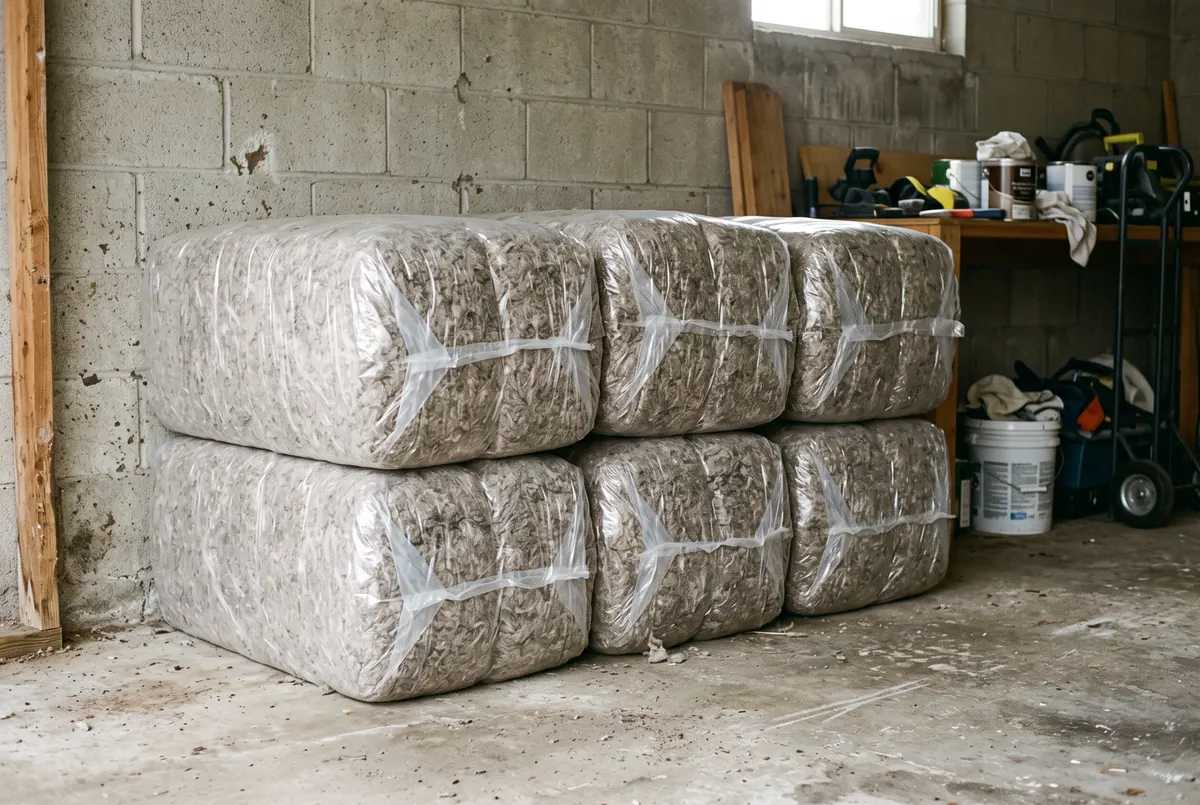
Everything below is computed from one named product, Owens Corning AttiCat blown-in fiberglass, 27.5 lb bag, at $67.58 a bag. That is a retail shelf price, read on the date in the sources note. A contractor buys below it, and the size of that discount has not been measured here, so it is not applied.
Figures: Insulation Report Cost Model, August 2026. Material price and coverage come from the maker's published chart, read 2026-08-07. Where the maker publishes no row, we work one out between the ones they do publish. The last column tells you which is which.
| Target | Sq ft per bag | Bags per 1,000 sq ft | Whole bags to buy | Retail material per 1,000 sq ft | Retail material per sq ft | Coverage basis |
|---|---|---|---|---|---|---|
| R-30 | 68.5 | 14.6 | 15 | $987 | $0.99 | Published point |
| R-38 | 52.8 | 19.0 | 19 | $1,281 | $1.28 | Interpolated |
| R-49 | 39.5 | 25.3 | 26 | $1,711 | $1.71 | Published point |
| R-60 | 31.8 | 31.4 | 32 | $2,125 | $2.13 | Published point |
The published-versus-interpolated distinction matters. The manufacturer publishes coverage at R-19, R-30, R-49, R-60, and those rows are read straight off the chart. R-38 sits between two of them and is computed here rather than read. Three methods could compute it, and they can be tested on a figure they are not given: working only from the three published rows below R-60, each predicts a different R-60 coverage against the manufacturer's published 31.8 square feet a bag.
- Interpolating the product of R times coverage, the method used here. That product behaves close to linearly, and it predicts 31.1 square feet a bag at R-60, within a square foot of the published figure.
- Extrapolating the coverage line itself. The same three rows predict 22.7 square feet a bag, well below the published figure, which would overbuy the job.
- Halving the R-30 coverage. The straight-proportion shortcut predicts 34.3 square feet a bag, so an order built on it lands about 7 percent short of the bags the job needs.
The blown-in method page works that arithmetic through the published rows in full, and the attic insulation calculator runs it on your own floor area.
Two consequences follow for a budget. Both are material effects, so they survive whatever a contractor charges for labor, and both are worth raising when a bid offers two targets at a difference that looks proportional.
- The material line is not proportional to the R-value. Doubling the target from R-30 to R-60 multiplies retail material per square foot by about 2.2, not by two, because loose fiber compresses under its own weight and a deeper layer is a denser one. The U.S. Department of Energy describes the same effect: settled density rises with installed thickness, so R-value does not scale strictly with depth.
- The last step up costs more than it looks. R-49 to R-60 is a 22 percent rise in target and about a 24 percent rise in material.
Doing it yourself: the saving, priced
One worked attic, 1,200 square feet to R-49, which is the ENERGY STAR retrofit target for a partly insulated attic in climate zones 4 through 8. The do-it-yourself column is material only, at the same retail price the model uses, bought in whole bags.
Figures: Insulation Report Cost Model, August 2026. Wages from BLS OEWS May 2025; material price and coverage read 2026-08-07. The installed column rests on the estimated burden and crew-hour inputs, so it is an estimate.
| Line | Do it yourself | Hire it out |
|---|---|---|
| Material, 31 bags at retail | $2,095 | Included |
| Labor, 10.8 to 14.4 crew-hours (estimate) | Your own time | Included |
| Blower rental, baffles, depth markers | Price locally | Included |
| Respirator, sealed eye protection, gloves, coveralls | Price locally | Included |
| Bag disposal and cleanup | Price locally | Included |
| Total | $2,095 plus the three priced-locally lines | $2,600 to $3,200 |
Subtract the column: $2,600 minus $2,095 is $505, and $3,200 minus $2,095 is $1,105. That gap, before any of the locally priced lines, is 19 to 35 percent of the installed figure, and it is the entire prize. It is smaller than the usual framing of this decision because material dominates the job and you buy material at the same shelf price the model does, while the contractor buys below it.
The three lines with no figure come straight out of that gap. Price them before you decide, not after. A machine day at the rental counter. Baffles by the rafter bay, plus depth markers. And a fitted respirator with sealed eye protection and gloves. The respirator is not optional in a hot closed attic full of loose fiber.
It helps to know how the rules run here. OSHA's breathing protection standard binds an employer over the crew it sends, so a contractor's people work under it. A homeowner in their own attic is outside it completely. The fiber in the air is the same either way. On a rented machine, protecting yourself is nobody's job but yours.
Two more things the table cannot show. 31 bags is about 853 lb of material to move, cut open and feed into a hopper, which is a second person's whole afternoon. And the crew-hour figure behind the labor line is an estimate drawn from secondary trade guidance, not a measurement, so the 10.8 to 14.4 crew-hours is a bracket for a crew that does this daily. A first attempt runs longer.
What moves the per square foot number
The model prices one thing: blowing loose fiber into an open, empty attic you can get into. Six things push a real per-square-foot figure away from that. The hub's quote table lists which scope lines push a bid above the band. What follows is what each one does to the per-unit math. That is a different question, and it is the one that tells you whether a bid is expensive for its size.
1. The target R-value, which is not linear
Shown above: R-30 to R-60 doubles the target and multiplies retail material per square foot by about 2.2. Installed, the same move runs from $1.46 to $1.93 per square foot up to $2.60 to $3.07. When a contractor quotes two options and the deeper one costs more than proportionally more, that is the material behaving normally, not a markup.
2. Access, which is hours rather than square feet
Hard access buys hours. And an hour is a fixed block, sitting against a labor line that shrinks with floor area. Take the billed rate of $52.64 to $78.96 a crew-hour, both inputs estimates. One extra hour is about 14 percent of the low end of the modeled labor line on an 800 square foot attic. On a 2,000 square foot one it is about 6 percent. That is why a tight hatch, a low roof pitch or no framing to walk on wrecks the per-square-foot figure on a small attic and barely scratches it on a big one. It is also why you cannot compare two bids per square foot when one attic is a crawl and the other is not.
3. Baffles, which follow the perimeter and not the floor
Rigid vent chutes go into every rafter bay at the eaves before loose fiber goes near the soffits. Priced per bay, the count tracks eave length: 75 bays per 100 feet of eave at 16 inches on center, 50 at 24 inches. Two attics of the identical 1,200 square feet do not carry the same number. A 20 by 60 foot rectangle has 120 feet of eave along its two long sides, about 60 bays at 24 inches on center; a square one of the same area has about 69 feet and 35 bays. Same floor, near enough twice the baffle line. Measure your own eave run before treating a baffle charge as padding.
4. Air sealing, which does not scale with area at all
Sealing the tops of walls, the holes for wiring and plumbing, dropped soffits and the edge of the hatch is slow hand work. Its hours follow how many holes are in your ceiling, not how many square feet. So a per-square-foot figure cannot carry it. Two bids on the same attic only compare per square foot if both include it or both leave it out. Ask which, then compare what is left.
5. Obstructions
Ducts lying across the joists. A masonry chimney that needs a dam built around it. Recessed lights with no insulation contact rating, which need clearance. Knee walls. And stored belongings that have to come out first. Every one is hand work before the hose even starts. None of it shows up in a number worked out from floor area.
6. Minimum job charges
The model is linear in floor area and the market is not. A 600 square foot attic to R-49 models at $1,300 to $1,600, of which the labor line is only $284 to $569 for 5.4 to 7.2 crew-hours, both estimated inputs. The installation cost page works the floor-price effect through in full.
Fiberglass and cellulose on price
The tempting shortcut is to reason from R per inch. Blown cellulose runs R-3.2 to R-3.8 per inch against blown fiberglass at R-2.2 to R-2.7, so cellulose reaches the same target in less depth. That does not translate into a price, because the cost of a blown job is bags, not inches. Bags come from a product's own coverage chart, which is set by its bag weight, its blown density and how much it settles. A denser material reaching a target in fewer inches can still weigh more per square foot and therefore need more material by weight. Depth and cost are different questions and the R per inch figure only answers the first.
To price a cellulose job, take two numbers off the exact product being quoted. The bag price, and the published coverage in square feet per bag at your target R-value, settled rather than freshly installed. Run those two through the same math as the table above. Floor area divided by coverage gives you bags. Bags times price gives you material. The FTC R-value Rule (16 CFR Part 460) requires a coverage chart on loose-fill packaging, and cellulose products are made to ASTM C739. So both numbers are on the bag or on the maker's sheet. The dollar figures on this page cover one fiberglass product. They do not price a cellulose job. The blown-in method page compares the two materials on density, dust, weight on your ceiling, and how each behaves out of a rental machine.
The rent-or-hire arithmetic
Run the condition test on the method page first. It asks whether the attic is safe and suitable to work in, and if yours fails any row there, the arithmetic below does not apply at all. For an attic that passes, this is the money version.
Start with what a do-it-yourself hour is actually worth. The labor line in this model is the trade wage times the burden multiplier, which comes to $52.64 to $78.96 per crew-hour. That is the gross rate your own hours earn against a quote, and it does not change with attic size or with target R-value. What changes with attic size is how many hours you buy at that rate.
Figures: Insulation Report Cost Model, August 2026. Labor line only. We take the BLS OEWS May 2025 national average wage, multiply by the estimated figure for what a worker costs beyond pay, and spread it over estimated crew hours. So every dollar here is an estimate.
| Attic floor area | Crew-hours (estimate) | Labor line, the maximum saving | Bags at R-60 |
|---|---|---|---|
| 800 sq ft | 7.2 to 9.6 | $379 to $758 | 26 |
| 1,000 sq ft | 9.0 to 12.0 | $474 to $948 | 32 |
| 1,200 sq ft | 10.8 to 14.4 | $569 to $1,137 | 38 |
| 1,500 sq ft | 13.5 to 18.0 | $711 to $1,421 | 48 |
| 2,000 sq ft | 18.0 to 24.0 | $948 to $1,895 | 63 |
Note what the third column does not do: it does not move with the target R-value. Raising the target buys more material, not more labor, in this model. A deeper blow does take somewhat longer in reality, so treat that as a limit of the model rather than a finding. The practical effect stands either way: the higher your target, the smaller the do-it-yourself saving as a share of the job.
Work down these in order and stop at the first that fits.
- Under about 1,000 square feet, at any target. The most the labor line can return is $948 and the low end is $474. Against a machine rental, a respirator, baffles and two people for a day, hire it out. The saving is too thin to carry the locally priced lines.
- Roughly 1,000 to 1,500 square feet, target R-30 to R-49, attic open and walkable, ceiling already air sealed. The labor line is $474 to $1,421 for 9.0 to 18.0 crew-hours. Renting is the reasonable call, with two able people and a full day booked rather than an afternoon.
- Over about 1,500 square feet, or any attic at R-60. The saving keeps growing, but so does the handling: 2,000 square feet at R-60 is 63 bags to move and feed. Rent only with three people and a cleared day, otherwise hire.
One thing the burdened rate hides, and it is the reason the recommendation leans toward hiring more often than a raw dollar gap suggests. The 2.0 to 3.0 multiplier on the wage is not profit, and the installation cost page takes apart what it actually buys. Doing the job yourself does not delete those costs, it moves them to you, as rental, as equipment and as risk. That multiplier is an estimate rather than a measurement, and it is the single input on this page most worth narrowing.
Get quotes for blown-in insulation
Tell us the job and your ZIP. We pass it to a licensed contractor who works in your area.
A marketing service, not a licensed contractor. Insulation work is performed by independent licensed local contractors.
- What happens next?
- Your request goes to a licensed insulation contractor near you, usually within about an hour during the day.
You may not need this
We do not sell insulation and we do not install it, which is why this section exists. Three cases where the bag count says buy less, or nothing.
- The gap left is under a bag per 100 square feet. ENERGY STAR recommends R-60 for a bare attic in climate zones 4 through 8, with lower targets in the warmer zones. An attic already measuring about R-50 needs roughly 5.6 more bags per 1,000 square feet to close the last R-10, which is about 0.6 of a bag per 100 square feet and $377 of material spread across the whole floor. Nobody mobilizes a machine, a crew and a truck for that, and heat flow falls as one over R, so the last increment returns a small fraction of the first. That R-10 threshold is an editorial judgement labeled as an estimate rather than a measurement. The depth checker turns your measured inches into an R-value range before you spend anything.
- The quote prices a bare attic and yours is not bare. A coverage chart gives the bags for a full install onto a bare ceiling, so a bid built straight off the target row prices material that is partly already up there. On 1,000 square feet going from about R-30 to R-60, the difference between the two chart rows is about 16.8 bags and $1,139 of material, against 31.4 bags and $2,125 for the full-depth row. New material compresses the settled layer under it, so treat that subtraction as a floor rather than an exact figure, and ask which row the bag count on your bid came from.
- The old material is coming out anyway. Where it is wet, moldy or rodent-fouled, bags blown on top get bought twice, once now and once after the removal that was always going to happen. Remove or add over runs that test. If there is loose vermiculite on the floor, stop and treat it as potentially asbestos-containing per EPA guidance.
Recommended levels above are ENERGY STAR retrofit guidance, based on 2021 IECC Residential Provisions Table R402.1.3. Energy codes cover new building and work done under a permit. They do not usually cover adding insulation to an attic you already have. Which edition applies where you live depends on your state, and often on your city. Your local building department is the only authority on it.
Related
Common questions
How much is blown-in insulation per square foot?
Material alone, at retail shelf price, is $0.99 per square foot at R-30, $1.71 at R-49 and $2.13 at R-60, computed from one named product's published price and coverage. Installed, the model on this site adds a labor line of $0.47 to $0.95 per square foot, giving $1.46 to $1.93 at R-30 and $2.18 to $2.66 at R-49. The labor side rests on a burden multiplier and a crew-hour figure that are estimates, not measurements.
How much does one bag of blown-in insulation cover, and what does it cost?
The measured anchor this site carries is Owens Corning AttiCat blown-in fiberglass, 27.5 lb bag at $67.58, a retail price read on the date in the sources note. Its published coverage is 110.7 square feet at R-19, 68.5 at R-30 and 39.5 at R-49. Coverage is the number that matters, not the price: one bag buys less area the deeper you go, so 1,000 square feet takes 15 whole bags at R-30 and 32 at R-60. Every product differs and its own bag label is the authority.
Why is a per-bag installed price higher at R-30 than at R-60?
Because a bag covers more floor at R-30, so more of the labor line rides on each one. In this model labor scales with floor area and not with depth, at $0.47 to $0.95 per square foot, while material is a flat $67.58 a bag. That puts the installed cost of a bag at roughly $100 to $132 at R-30 and $83 to $98 at R-60. The labor side of those rests on a burden multiplier and a crew-hour figure that are estimates, not measurements. Two per-bag quotes at different targets cannot be compared at all until both are converted to a per-square-foot figure.
What is the do-it-yourself saving on blown-in insulation, in dollars?
Smaller than the headline suggests, because material dominates the job. On a 1,200 square foot attic to R-49, 31 bags at retail is $2,095, against a modeled installed $2,600 to $3,200, whose labor side rests on a burden multiplier and a crew-hour figure that are estimates rather than measurements. The whole prize is $505 to $1,105, or 19 to 35 percent, and out of it come the blower rental, a fitted respirator, eye protection, gloves, baffles, depth markers and the trips. Price those locally before deciding. You also buy material at the same retail price a contractor buys below.
Why does doubling the R-value cost more than double in material?
Loose-fill compresses under its own weight, so a deeper layer is a denser layer and yields less R per inch than a shallow one. The manufacturer's own chart shows it: R times coverage per bag falls as the labeled R rises. Going from R-30 to R-60 doubles the target but multiplies retail material cost per square foot by about 2.2. Halving the R-30 coverage to get an R-60 figure predicts 34.3 square feet per bag where the manufacturer publishes 31.8, so an order built on the shortcut lands about 7 percent short of the bags the job needs.
Does blown cellulose cost less than blown fiberglass?
R per inch cannot answer that. Cellulose runs R-3.2 to R-3.8 per inch against fiberglass at R-2.2 to R-2.7, so it reaches a target in less depth, but the cost of a blown job is bags rather than inches, and bags come from a product's own coverage chart, bag weight and settled density. A denser material that needs fewer inches can still need more material by weight. To price a cellulose job, take the bag price and the published coverage at your target R-value from the specific product being quoted and run the same two steps as the table on this page: floor area divided by coverage gives bags, bags times bag price gives material. The figures here are for one fiberglass product and do not price cellulose.
How many bags do I need for a 1,000 square foot attic?
For the anchor product, 15 whole bags at R-30, 19 at R-38, 26 at R-49 and 32 at R-60, each rounded up from the exact coverage figure because bags are sold whole. R-30 and R-49 sit on the manufacturer's published coverage points; R-38 and R-60 are interpolated between and beyond them. Round up rather than down, because a hopper left short at the far corner of an attic costs a second trip. The bag label of the product actually blown is the authority over any table.