
Attic insulation removal
By Insulation Report Editorial. Last reviewed August 2026. How we research this.
In brief
Most attics do not need the old insulation taken out. If the layer up there is dry, free of droppings and mold, and just not thick enough, the standard fix is to add new insulation on top. That is cheaper, and it works just as well.
Removal is necessary in five cases. Water damage or mold. Rodent or bat mess. Fire and smoke damage. Vermiculite that may hold asbestos. And material so packed down or broken up that it no longer holds its rated R-value. Plain removal runs roughly $1 to $2 a square foot.
Fouled material runs about $2 to $4. Suspected asbestos is a separate licensed trade. And if you are truly on the fence, here is the best reason to remove: a bare attic floor is the only easy chance you will get to seal the ceiling properly.
This page is about when taking insulation out is the right call and when it is money wasted. We do not remove insulation and we do not sell it, which is why the honest answer here is often "leave it alone and add more on top."
First: you probably do not need removal
What removal actually looks like halfway through
The line across this attic is the job: cleared and bare on one side, old material on the other. Most attics never need this, which is what the test below is for.
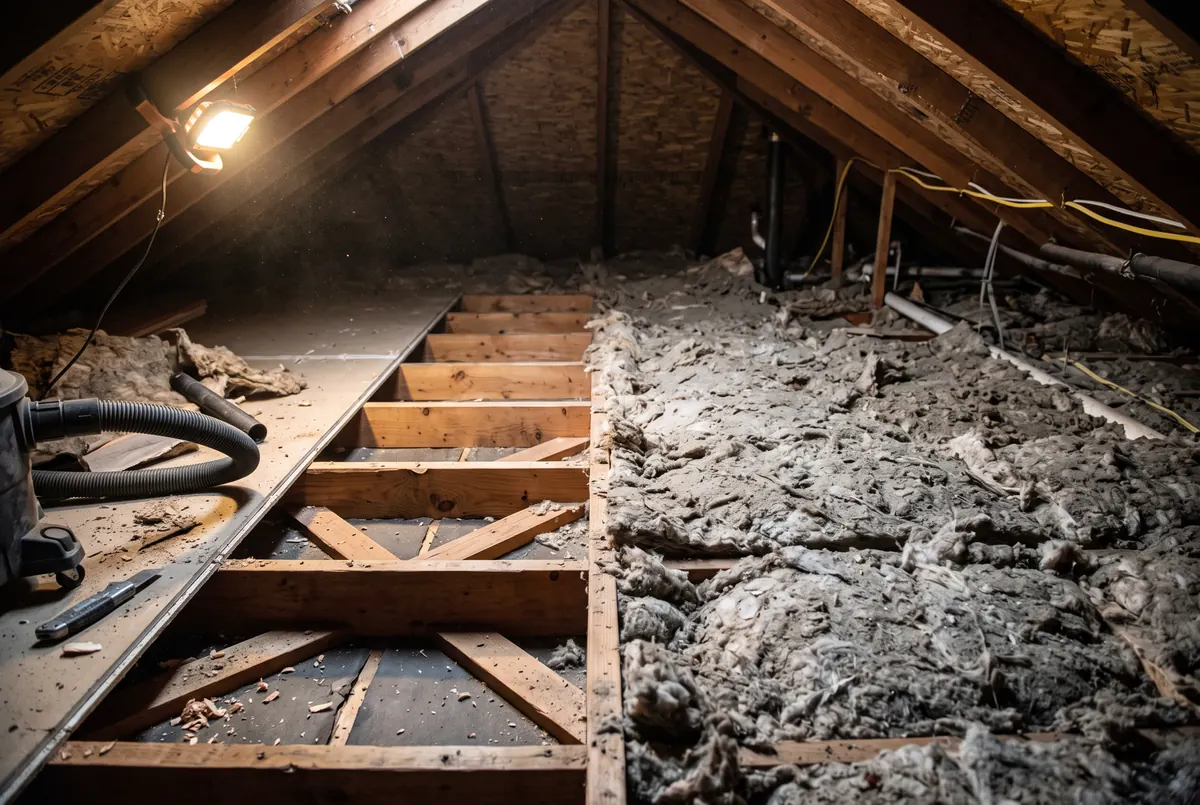
The most common reason a homeowner searches for insulation removal is that their attic is under-insulated and their energy bills are high. That is a real problem with a cheaper solution. The Department of Energy's guidance on adding attic insulation is that new material can generally go directly over old, and the R-values add together. Removing a perfectly serviceable layer first means paying to throw away insulation that is still working, then paying again to replace what it was doing. Whether your attic is the exception is worked through, condition by condition, in remove or add over.
A contractor who inspects your attic and immediately recommends full removal and replacement, without pointing to one of the five conditions below, is quoting the more expensive job. Ask which specific condition applies and ask to see it. A straight answer is easy to give when the reason is real.
The one technical exception people miss
There is a case where you cannot simply add over the top, and it has nothing to do with the old material being bad. Never install a second faced batt over an existing faced layer. The facing (usually kraft paper or foil) is a vapor retarder, and it belongs on the warm-in-winter side of the assembly. A second retarder above the first traps moisture between them, inside the insulation, where it condenses. If you are adding batts over existing faced batts, use unfaced material, or slash the facing of the new layer. Blown-in loose fill has no facing and does not have this problem.
The five situations that do require removal
| Condition | How you recognize it | Why adding over does not work |
|---|---|---|
| Water damage or mold | Staining on the deck or joists, matted or slumped insulation, a musty smell, visible growth | Wet insulation loses most of its R-value and does not reliably dry inside a closed assembly. Burying it keeps the moisture and the growth in place. See mold in attic insulation |
| Rodent or bat contamination | Droppings, tunnelling and nests in the loose fill, a persistent ammonia smell, chewed wiring | Urine and droppings stay biologically active and keep smelling. Covering them seals a contaminated layer into the ceiling. See rodent contamination |
| Fire or smoke damage | Soot on the deck, a smoke smell that returns in hot weather | Smoke residue is absorbed into loose fill and keeps releasing odor as the attic heats. It does not air out |
| Vermiculite (possible asbestos) | Loose pebble-like granules, grayish-brown or silver-gold, roughly the size of a grain of rice, that puff and layer | This is a health question, not a performance one, and the correct first step is usually to not disturb it. See vermiculite and asbestos |
| Severe compaction or degradation | Loose fill that has settled to a fraction of its original depth, or old material that crumbles to dust when handled | Compressed insulation has lost the trapped air that gives it its R-value, and it will not recover. Adding over it is fine performance-wise, but if it has degraded to dust it is worth clearing |
Notice which of these are health-driven and which are performance-driven. Contamination, mold and vermiculite are about what you and your family breathe. Compaction is about money. They deserve different urgency.
What removal costs
Method: the ranges below are compiled from contractor-published price lists and quoted ranges current in 2026, expressed per square foot of attic floor area. They are typical ranges, not quotes. Access, attic height, insulation depth, and how far the crew has to carry bags all move the real number, and regional labor rates move it more than anything else on this list.
| Job | Per sq ft | 1,200 sq ft attic | Notes |
|---|---|---|---|
| Blown-in removal, clean and accessible | $1.00 to $2.00 | $1,200 to $2,400 | The baseline job |
| Batt removal, clean | $0.80 to $1.50 | $960 to $1,800 | Faster than loose fill, less equipment |
| Contaminated (rodent, mold) | $2.00 to $4.00 | $2,400 to $4,800 | Bagging, disposal, deck cleaning and treatment |
| Removal plus air sealing plus new blown-in | $3.50 to $6.50 | $4,200 to $7,800 | The complete job most people actually want |
| Vermiculite or confirmed asbestos | separate trade | often $3,000 to $8,000+ | Licensed abatement, permits, air clearance testing |
Two things move these numbers more than homeowners expect. Access is the first: a pull-down ladder into a low attic with no walkway can add half again to the labor, because every bag has to be dragged to the hatch. Disposal is the second, and it is often a separate line item, because bagged loose fill is bulky and some landfills charge by volume rather than weight.
Full breakdown, including what a fair quote itemizes: insulation removal cost.
How the job is actually done
Most of a removal day is spent protecting the house
The hose has to reach the attic through your hallway. Masking, floor protection and a sealed route are what separates a clean job from a week of fibers in the carpet.
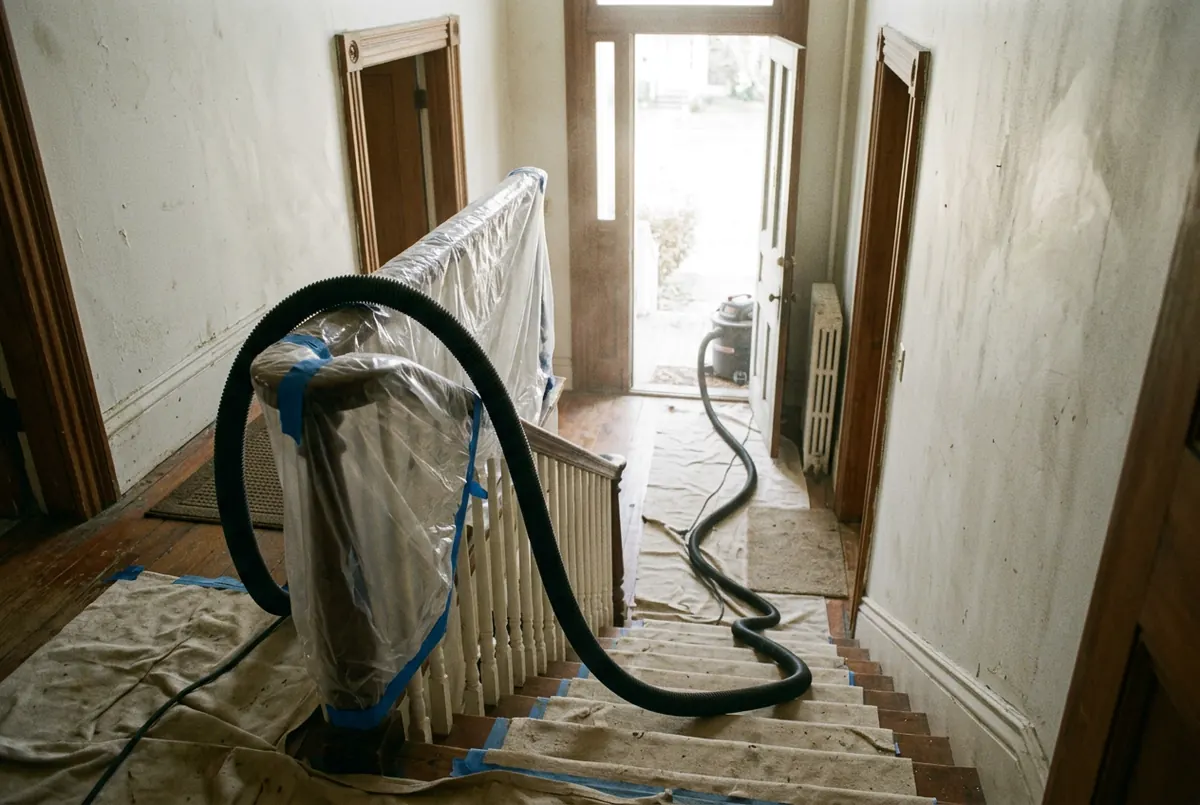
Knowing the sequence makes it much easier to tell a thorough contractor from a fast one.
- Inspection and identification. What the material is, how deep, whether it is contaminated, and whether anything present looks like vermiculite. This decides everything after it, and naming it from the hatch is a ten-minute job you can do yourself.
- Containment. Plastic sheeting over the hatch and a protected path from the attic access to the exterior. On contaminated jobs the work area is put under negative pressure so dust does not push into the house.
- Vacuum removal. A gas or electric insulation vacuum, usually parked outside, with a long hose run into the attic. Material goes straight into disposal bags. See how insulation vacuums work.
- Hand clearing. Batts, blocked cavities, and anything the hose cannot reach come out by hand.
- Deck cleaning. HEPA vacuuming of the joist bays and deck. On contaminated jobs, an antimicrobial or enzymatic treatment follows.
- The air sealing window. With the deck bare, top plates, wire and pipe penetrations, chases and recessed light housings are all visible and reachable. This is where the real energy savings come from, and it is only easy right now.
- Baffles and ventilation check. Soffit vents get baffles so the new insulation cannot block airflow at the eaves.
- New insulation, if it is a combined job. Blown to a marked depth, with a depth ruler left in place so the work can be verified.
Step six is the one to insist on. Taking the insulation out and blowing new material straight back in, without sealing the ceiling first, wastes the best chance this house will ever give you. Air leaking through the ceiling is a big part of what makes an attic uncomfortable, and insulation on its own does not stop moving air. If your goal is a lower energy bill rather than fixing contamination, the order of value is usually this. Sealing first. Then depth. Then ventilation. And removal only if one of the five conditions applies.
What to ask before you accept a quote
- "Which of the five conditions applies to my attic, and can you show me?" If removal is genuinely needed, this is easy to answer.
- "Is air sealing included, itemized separately, or not included?" The most common gap in a removal quote.
- "Is disposal in the price?" Often a separate charge.
- "What depth of new insulation, and to what R-value?" Get both in writing, the inches and the target R-value. Then compare that against the level recommended for your climate zone.
- "Will you install baffles at the soffits?" Blocked eave vents cause moisture problems later.
- "Are you licensed and insured, and can I have the numbers?" Rules vary by state. A contractor should hand over license numbers when asked.
Get quotes for an insulation removal job
Tell us what you are dealing with and your ZIP. We pass it to a licensed contractor who works in your area.
A marketing service, not a licensed contractor. Insulation work is performed by independent licensed local contractors.
- What happens next?
- Your request goes to a licensed insulation contractor near you, usually within about an hour during the day.
Doing it yourself: when that is reasonable and when it is not
This is genuinely a job some homeowners can do. It is also a job that sends people to hospital, so the line matters.
| Reasonable to do yourself | Hire a licensed contractor |
|---|---|
| Dry, clean loose fill or batts | Anything that might be vermiculite. Stop and read this first |
| A walkable attic with decent headroom and a real floor or walkway | Rodent or bat droppings of any quantity |
| Small area, and you can rent an insulation vacuum | Visible mold, or insulation that is wet or matted |
| You own or will buy a fitted respirator, goggles, gloves and a disposable suit | Knob-and-tube wiring, which must be assessed before anything is disturbed |
| You have somewhere to take a large volume of bagged waste | Low-clearance, cathedral or spray-foamed assemblies |
The protective equipment is not optional in either column. Loose-fill fiberglass and cellulose both produce a great deal of airborne dust when disturbed, attics run extremely hot, and the combination of heat, a respirator and confined crawling is harder than it sounds. If you do it yourself, work in the early morning, take breaks, and do not work alone.
Common questions
Do I have to remove old attic insulation before adding more?
Usually not. The Department of Energy says adding insulation on top of what is there is normally fine, as long as the old layer is dry, clean and not squashed flat. You do need to remove it when the material is wet, moldy, rodent fouled, or damaged by fire or smoke. Same if it is vermiculite that may hold asbestos. One technical trap catches people out. Never lay a second faced batt over an existing faced layer. The second vapor barrier can trap water between them. See remove or add over for the full decision.
How much does it cost to remove attic insulation?
Contractors generally publish about $1 to $2 a square foot for plain blown-in removal. It runs roughly $2 to $4 a square foot when the material is fouled and has to be handled as a biohazard, or when the attic is hard to get into. If asbestos is suspected, that is a separate trade at a separate price. See the full cost breakdown.
Can I remove attic insulation myself?
Physically, yes, for dry uncontaminated material in a walkable attic, using a rented insulation vacuum. It is unpleasant, dusty work in a confined hot space and it needs a properly fitted respirator, eye protection and full skin cover. Do not do it yourself if the material is or might be vermiculite, if there are rodent droppings, or if there is visible mold. Those three carry health risks that ordinary care does not manage.
How long does insulation removal take?
A crew of two typically clears a 1,000 to 1,500 square foot attic of blown-in insulation in four to eight hours. Batts come out faster than loose fill. Contaminated jobs take longer because the material is bagged more carefully and the deck is cleaned and treated afterwards.
Does homeowners insurance cover insulation removal?
Sometimes, when the damage comes from a covered peril. Removal after a burst pipe, a roof leak from storm damage, or a fire is often covered as part of the repair. Removal because the insulation is simply old, settled or inadequate is a maintenance item and is not covered. Rodent damage is excluded by many policies. Check your own policy wording rather than assuming.
What is left behind after the insulation is removed?
A bare attic floor with the joists showing, plus everything that was buried under the insulation. Wiring. Junction boxes. Recessed light housings. And every hole through the ceiling. This is the one moment when air sealing is easy and cheap. Skipping it is the most common expensive mistake on a removal job.