
Insulation R-value chart
By Insulation Report Editorial. Last reviewed August 2026. How we research this.
In brief
R-value tells you how well a material blocks heat moving through it. The higher the number, the slower heat crosses. For attics, ENERGY STAR recommends R-30 in climate zone 1, which is the southern tip of Florida plus Hawaii. It recommends R-49 in zones 2 and 3, across the south.
And R-60 in zones 4 through 8, which is most of the country. If your attic already has 3 to 4 inches, your targets drop to R-25, R-38 and R-49 for those same zones. To turn a target into inches, divide it by the R-value of one inch of your material.
Blown fiberglass gives about 2.2 to 2.7 an inch. Cellulose gives 3.2 to 3.8. Closed-cell spray foam gives 6.0 to 7.0. These are recommendations for an existing home, not law. The 2021 IECC sets similar minimums for new building. What each state actually enforces ranges from a 1989 code to the 2024 IECC.
Recommended attic R-value by climate zone
Figure 1
The 2021 IECC climate zones, by county
Zone 1 is the hottest and zone 8 the coldest, and the zone sets the attic R-value worth aiming for. Zones follow county lines, not state lines, so find your county rather than your state: several states span three zones.
- Zone 1 R-30
- Zone 2 R-49
- Zone 3 R-49
- Zone 4 R-60
- Zone 5 R-60
- Zone 6 R-60
- Zone 7 R-60
- Zone 8 R-60
This chart is ENERGY STAR's published recommendation, from "Recommended Home Insulation R-Values." ENERGY STAR says that guidance is based on Table R402.1.3 of the 2021 International Energy Conservation Code. ENERGY STAR lumps some zones together where the values match. We split them back out so every zone has its own row. The second column is for a bare or nearly bare attic. The third is the lower target for an attic that already has 3 to 4 inches. That third case is the common one: an older house that was insulated once and never topped up.
| Climate zone | Uninsulated attic | Existing 3 to 4 inches | Roughly where |
|---|---|---|---|
| Zone 1 | R-30 | R-25 | Southern tips of Florida and Texas, Hawaii |
| Zone 2 | R-49 | R-38 | Most of Florida, the Gulf coast, south Texas |
| Zone 3 | R-49 | R-38 | The south from the Carolinas to central Texas, southern California |
| Zone 4 | R-60 | R-49 | The mid-Atlantic, the lower Midwest, the marine Pacific coast |
| Zone 5 | R-60 | R-49 | The band from Nebraska through Pennsylvania and southern New England |
| Zone 6 | R-60 | R-49 | Northern New England, the upper Midwest, the mountain West at elevation |
| Zone 7 | R-60 | R-49 | Northern Minnesota, North Dakota, northern Maine |
| Zone 8 | R-60 | R-49 | Interior and northern Alaska |
Treat the geography column as orientation, not a lookup. Zones follow county lines. The insulation depth checker turns a ZIP into a zone from the same Pacific Northwest National Laboratory county data for the 2021 IECC. For all eight zones one at a time, with the model code minimum beside each recommendation, see R-value by climate zone. It also covers the A, B and C moisture letters, which do not move your attic target.
R-value per inch by material
Every figure here is a range, never a single number. R per inch moves with the product, the density and the way it went in. The last two columns turn each range into the inches you need to reach R-49 and R-60 from bare, using the material's best and worst R per inch. R-value per inch by material carries the spread inside each range, how a label R-value is tested, and why per inch is the wrong number to shop on.
| Material | Form | R per inch | Inches to R-49 | Inches to R-60 |
|---|---|---|---|---|
| Blown-in fiberglass | Loose fill | 2.2 to 2.7 | 18.1 to 22.3 | 22.2 to 27.3 |
| Blown-in cellulose | Loose fill | 3.2 to 3.8 | 12.9 to 15.3 | 15.8 to 18.8 |
| Loose-fill mineral wool | Loose fill | 2.8 to 3.7 | 13.2 to 17.5 | 16.2 to 21.4 |
| Fiberglass batts | Batt | 2.9 to 3.8 | 12.9 to 16.9 | 15.8 to 20.7 |
| Mineral wool batts | Batt | 3.3 to 4.2 | 11.7 to 14.8 | 14.3 to 18.2 |
| Open-cell spray foam | Spray foam | 3.5 to 3.7 | 13.2 to 14 | 16.2 to 17.1 |
| Closed-cell spray foam | Spray foam | 6 to 7 | 7 to 8.2 | 8.6 to 10 |
These are settled, aged values from published material data. We carry them as ranges in our reference data. For loose fill, the inches columns are estimates, not straight conversions, because deeper loose fill packs down under its own weight. Spray foam is sprayed by a contractor to a set thickness. So its inches columns describe what was ordered, not something you measure later.
Radiant barrier is left off this table on purpose. It reflects radiant heat instead of slowing heat through material, so it has no R per inch to list. Which material to pick, and where each one belongs, is the subject of the insulation types guide.
Recommendation, model code and enforced code are three different numbers
Three numbers get collapsed into one claim, usually "code requires R-60". Only the first of them applies to most readers. The chart above is ENERGY STAR retrofit guidance for a house that already stands, and nothing makes you follow it. The model 2021 IECC sets a ceiling minimum for new and permitted work, R-60 in zones 4 through 8. It binds nobody until a state or city adopts it. What your state enforces is a third number again. Energy codes cover new building and work done under a permit. They do not usually cover adding insulation to an attic you already have. Which edition applies where you live depends on your state, and often on your city. Your local building department is the only authority on it.
Figure 2
Only 12 of 51 jurisdictions are on the 2021 IECC or newer
Which edition a state has adopted, colored coldest for the weakest. The claim that code requires R-60 in your attic assumes the darkest band; most of the country is not in it, and none of it applies to a voluntary top-up.
- No mandatory statewide code (8)
2012 IECC or older (8)
2015 IECC (11)
2018 IECC (12)
2021 IECC or newer (12)
R-value by climate zone puts the model code figure beside the recommendation in every zone. It also covers the raised-heel allowance that lets R-49 stand in for R-60. The full 51-row table behind this chart is on the state energy code tracker. It goes state by state, showing what each one enforces and what that means for a top-up you choose to do.
Why loose-fill R-value does not scale with depth
The measurement that settles most of this page
Part the material down to the top of a joist and you have a datum you can trust. Everything above that line is what you have; the target tells you what is missing.
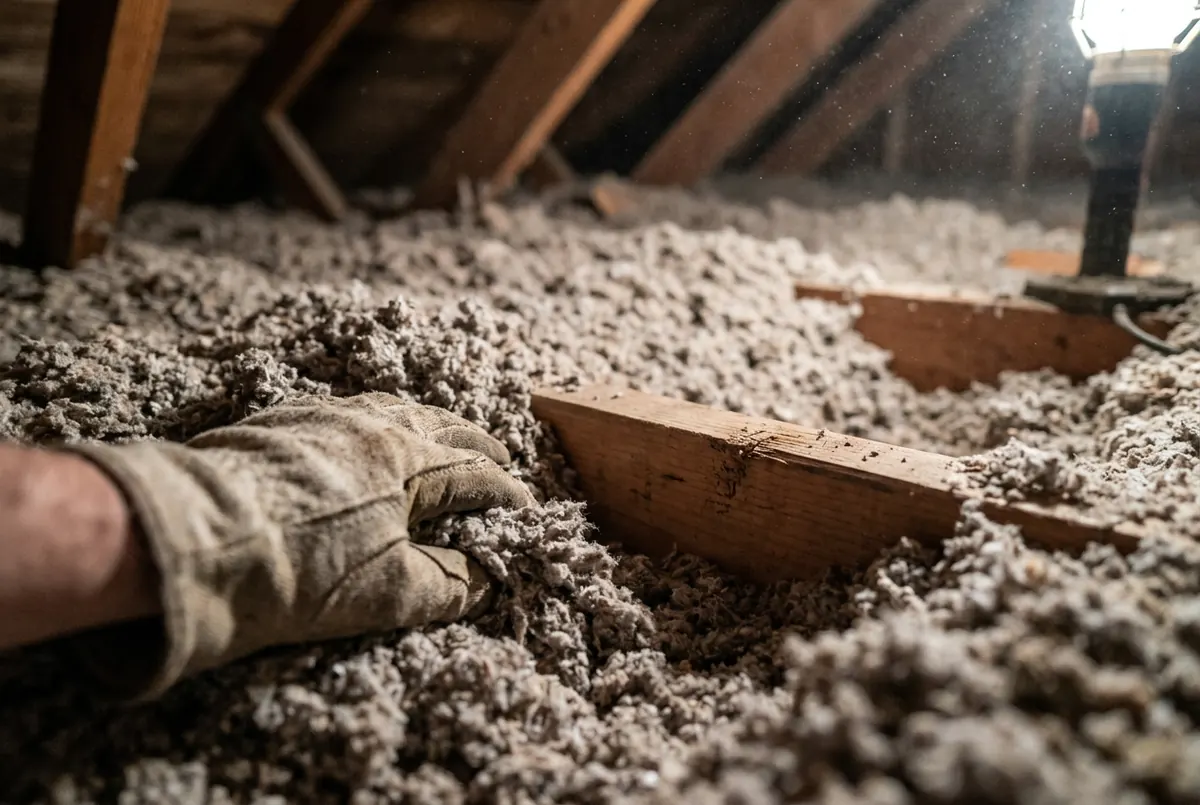
Inches times R per inch works for batts and boards. For loose fill it drifts. DOE documents that settled density rises as installed thickness rises, so each added inch buys a little less than the one before it. Owens Corning's published coverage per bag for AttiCat blown-in fiberglass shows it in one product's own numbers. R-value per inch by material works that coverage chart through and prices the ordering error. Trust the bag label for your product. The depth checker carries the ranges and the warning built in.
What R-value does not capture
R-value measures one thing: resistance to conducted heat through the material, under test conditions. Four things that decide how an attic actually performs are outside the number entirely.
- Air leaking through. Warm air slips through gaps around light fixtures, plumbing pipes, the attic hatch and the tops of walls. That heat goes past the insulation, not through it. This is why DOE's attic guidance puts air sealing before insulating. Insulation laid over an unsealed ceiling does worse than its label says. Sometimes much worse.
- Wind washing. At the eaves, air entering the soffit vents can wash through the edges of low-density insulation and strip its performance exactly where the depth is already thinnest. Baffles at the eaves exist to stop this, and their absence does not show up in any R-value.
- Moisture. Wet insulation conducts heat far better than dry, and loose-fill that has been soaked and dried usually stays degraded because the fibers mat. A roof leak can quietly delete the R-value of everything under it, and mold follows.
- Heat taking the shortcut. Wood joists carry heat better than the insulation beside them. So a framed ceiling does worse than the label on the material in its bays, until the insulation covers the joist tops too. That is one reason deep loose fill over the whole floor beats batts of the same rated R fitted between joists.
A radiant barrier belongs on this list from the other side. It goes after a kind of heat flow R-value never measures, and it has no R-value of its own. A radiant barrier reflects radiant heat rather than resisting conduction, so it has no useful R-value per inch and cannot be counted toward an R-value target. It is measured differently from bulk insulation and the two do not add together. If a product sheet quotes an "equivalent R" for foil, it is describing a whole assembly under kind test conditions. It is not describing the foil.
What your attic should target
Four steps get you to a number. Find your zone. Measure the depth in three or four spots away from the hatch. Read your target off the chart above. Then divide the gap by the R per inch of what you plan to add. How much insulation do I need runs the whole sequence, with a five-reading measuring method, a decision table that ends in an action, and a worked zone 5 example.
Two things to hold on to here. The targets on this page are attic targets. The model code sets separate, lower minimums for walls and floors, because framing depth constrains them. Old insulation stays put unless it is wet, moldy, rodent contaminated or might be vermiculite. The remove-or-add-over guide tests that properly. What closing a gap costs is on the insulation cost guide, which builds a price from wage data and material coverage rather than asserting one.
You may not need more insulation
We do not sell insulation and we do not install it, which is why this section can exist. If your measurement lands within about R-10 of the recommendation, more depth is unlikely to be the best use of the money. That R-10 line is our own estimate, not a published rule. The first inches over a bare deck do most of the work, so going from R-11 to R-30 changes a heating bill, while going from R-49 to R-60 is a rounding error on most of them.
Figure 3
The curve every insulation decision sits on
Conducted heat flow through the ceiling goes as one over R, so the same eleven R-values remove far less at the top of the curve than at the bottom. The dashed lines are the ENERGY STAR level for each zone group.
At that point the better buy is almost always the ceiling itself. Air sealing the holes, the hatch and the tops of the walls goes after heat loss that R-value cannot see. It usually costs less than a top-up. And it makes the insulation you already have work closer to its label. How much insulation do I need turns a measurement into that call. It also covers the two other cases where you spend nothing on depth. One is work due on the roof, the wiring or the vents, which tears up insulation and spends the money twice. The other is an attic spray foamed at the roof, where these floor targets do not apply at all.
The rest of this section
This page is the chart. Three pages go past it, each taking one question the chart raises and answering it properly.
- R-value by climate zone: all eight zones, one at a time, with the retrofit recommendation, the model code minimum, and the depth each target takes in every common material.
- How much do I need?: the sequence from measuring what is up there to deciding whether to add depth or air seal instead.
- R-value per inch by material: how a label R-value is tested, why per inch is the wrong unit to shop on, and what a joist depth is worth in each material.
Related
Common questions
What R-value do I need in my attic?
ENERGY STAR recommends R-30 in climate zone 1, which is only the southern tip of Florida and Hawaii, R-49 in zones 2 and 3 across the south, and R-60 in zones 4 through 8, which is most of the country. If your attic already has 3 to 4 inches, the top-up targets drop one step, to R-25, R-38 and R-49 for the same zones. These are retrofit recommendations for an existing home, not code requirements. The depth checker on this site looks up the zone from your ZIP and compares it with what you measure.
How many inches of insulation is R-49?
It depends on the material. R-49 is about 18.1 to 22.3 inches of blown fiberglass, which gives R-2.2 to R-2.7 an inch. In blown cellulose it is about 12.9 to 15.3 inches, at R-3.2 to R-3.8 an inch. Both are ranges, because R per inch changes with the product and with how densely it goes in. Both are estimates too, because loose fill settles. The deeper the pile, the more the bottom of it packs down. The label on the bag you buy is the authority on coverage and on how deep to lay it.
Is a higher R-value always better?
More R-value always slows more heat. But the payoff drops off fast. The first inches do most of the work and the last ones do the least. Going from a nearly bare attic to R-30 changes a house. Going from R-49 to R-60 is a small gain that takes a long time to pay back. R-value also only covers heat moving through material. An attic with a leaky ceiling loses heat in moving air, and no amount of depth stops that. So if your current level is anywhere near the recommendation, air sealing is usually the better buy.
Is the R-value chart the same as what code requires?
No. The charts on this page are recommended levels for a home that already exists. Nobody makes you follow them. An energy code is different. It applies to new building and to work under a permit. It changes by state, and often by city. And in most states it comes from an older edition than the one these recommendations are based on. The state energy code tracker lists what each state really enforces. Your local building department is the only authority on your address.
Do R-values add together when I layer insulation?
For bulk insulation, yes. R-values in a stack add, which is why topping up works: R-19 of old fiberglass under R-30 of new cellulose is roughly R-49, provided the old layer is dry and not compressed by the new work. Two caveats. Compression costs R-value, so batts laid over loose fill should go across the joists without squashing what is underneath. And a radiant barrier does not join the addition: it reflects radiant heat rather than resisting conduction, so it has no R per inch to contribute and cannot be counted toward a target.
Which insulation has the highest R-value per inch?
Closed-cell spray foam, at about R-6 to R-7 per inch, roughly double loose fill. That matters where space is tight: cathedral ceilings, rim joists, walls. It matters much less on an open attic floor, where depth is close to free and blown fiberglass or cellulose reach any target for far less money. Buying the highest R per inch for an open attic is paying a premium to solve a constraint you do not have. Choose by the space available and the budget, not by the per-inch number alone.