
Attic insulation installation cost
By Insulation Report Editorial. Last reviewed August 2026. How we research this.
In brief
Labor is the smaller part of an attic insulation bill. It is also the part that swings most. The BLS May 2025 average wage for insulation workers, SOC 47-2131, is $26.32 an hour. A contractor bills roughly 2.0 to 3.0 times that, or about $52.64 to $78.96 per crew-hour.
That covers payroll tax, workers compensation, liability cover, vehicles, the blowing machine, disposal, overhead and profit. The multiplier is an estimate, not a measurement. Now the hours. At 9 to 12 crew-hours per 1,000 square feet, also an estimate, a 1,200 square foot attic takes 10.8 to 14.4 crew-hours.
That is roughly $569 to $1,137 of labor, or about 22 percent of the modeled low total. Ask what those hours buy: protection, baffles, air sealing, depth markers, blowing, cleanup. A quote that is cheap on labor is usually a quote that skipped some of them.
The cost hub prices the finished job, material plus labor, by attic size and target R-value. This page is the labor line: the part of a quote a homeowner has no independent way to price, and the part where two bids for the same attic diverge.
The labor line, taken apart
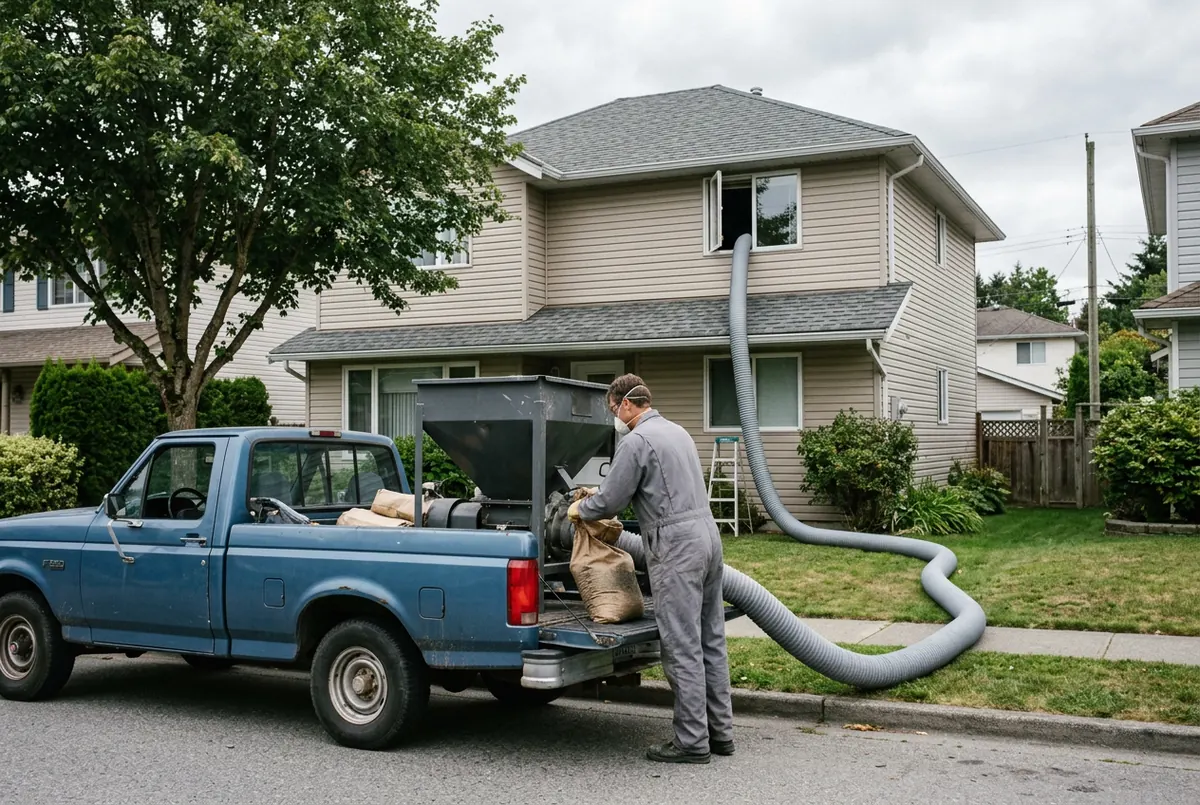
Why the labor line is two people, not one
One stays at the machine feeding it; one is in the attic with the hose. Neither can do the other job at the same time, which is why the crew-hour figure doubles before the work starts.
From a wage to a billed rate
The starting number is public. The Bureau of Labor Statistics publishes average hourly wages by job in its Occupational Employment and Wage Statistics program. The attic trade is SOC 47-2131, Insulation Workers, Floor, Ceiling and Wall. Its May 2025 national average is $26.32 an hour. (Watch out for SOC 47-2132. That is mechanical insulation, wrapping pipes and ducts. Different trade, different pay, wrong number for this.)
That wage is what reaches the worker, not what appears on your invoice. A contractor bills a multiple of it, carried here as 2.0 to 3.0 times base wage, the ordinary construction burden range. Applied to the national mean, one crew-hour bills at $52.64 to $78.96. What sits inside that gap:
| What the multiplier carries | Why it is in the rate rather than optional |
|---|---|
| Payroll tax and unemployment insurance | Employer-side contributions on every wage dollar, before anyone reaches your house |
| Workers compensation | A high class rate for this trade: kneeling on joists above a ceiling that is not a floor, in a confined space at attic temperatures, in respiratory protection under OSHA's standard. Insurers price that |
| General liability | A hose run through a finished house, a machine on the drive, loose material everywhere. Standard for a working contractor and commonly required before a permit office or a homeowner will let work start, not an extra |
| Vehicles, the machine and the hose | A truck sized to carry a blowing machine and a job's worth of bags, and the machine itself, hauled and set up for every job |
| Consumables and disposal | Baffles, dams, floor and stair protection, filters, empty bags out. Small per job, constant across every job |
| Unbilled hours | The site visit that produced your quote, the scheduling and the drive, recovered inside the hourly rate of the jobs that close |
| Overhead and profit | Office, phone, licensing, and the margin that keeps the business alive long enough to answer a warranty call |
The multiplier is an estimate, drawn from the ordinary construction range rather than measured against real invoices, which is why it is carried as a range at all. Every hourly figure below inherits that, so treat them as a bracket for checking a quote against, not as a rate anyone owes you.
What that comes to on a real attic
We estimate crew time at 9 to 12 crew-hours per 1,000 square feet of attic floor. That comes from second-hand trade guidance, which describes a two-person crew taking 3 to 6 hours on a typical attic. We scaled it to 1,000 square feet so it can be stretched to any size. But that means a bigger attic runs past the band the guidance itself describes. Take the 1,200 square foot attic below. 10.8 to 14.4 crew-hours works out to 5.4 to 7.2 hours on site for two people. The top of that is already past the 6 hours the source describes. It is an estimate, and a larger attic stretches it further still.
Figures: Insulation Report Cost Model, August 2026. Wage from BLS OEWS May 2025, SOC 47-2131; the burden and crew-hour inputs are estimates, and every dollar figure in this table inherits that.
| Step | Figure | Basis |
|---|---|---|
| Crew-hours, 1,200 sq ft | 10.8 to 14.4 | Estimate. 9 to 12 per 1,000 sq ft |
| Billed crew-hour | $52.64 to $78.96 | Estimate. The BLS national mean wage times the 2.0 to 3.0 burden range |
| Labor only | $569 to $1,137 | Hours times billed rate. No material, no extras |
| Labor per square foot | $0.47 to $0.95 | Labor only, divided by floor area |
The wage and the burden multiplier that sit behind the billed rate, and the basis of each, are set out on the cost hub alongside the material inputs. For scale here, the material on the same attic to R-49 is 30.4 bags of blown fiberglass at the retail shelf price of $67.58 a bag, which is $2,054, so labor is about 22 percent of the modeled low total. A contractor buys the bags below retail, which pushes the real labor share a little higher than that. Insulation cost per square foot shows that labor share at each target R-value.
Where the crew's hours actually go
The last four feet cost the most
Clearance at the eave runs out long before the insulation should. Getting depth into that wedge is slow, awkward work, and it is where an hourly estimate built on open floor area goes wrong.
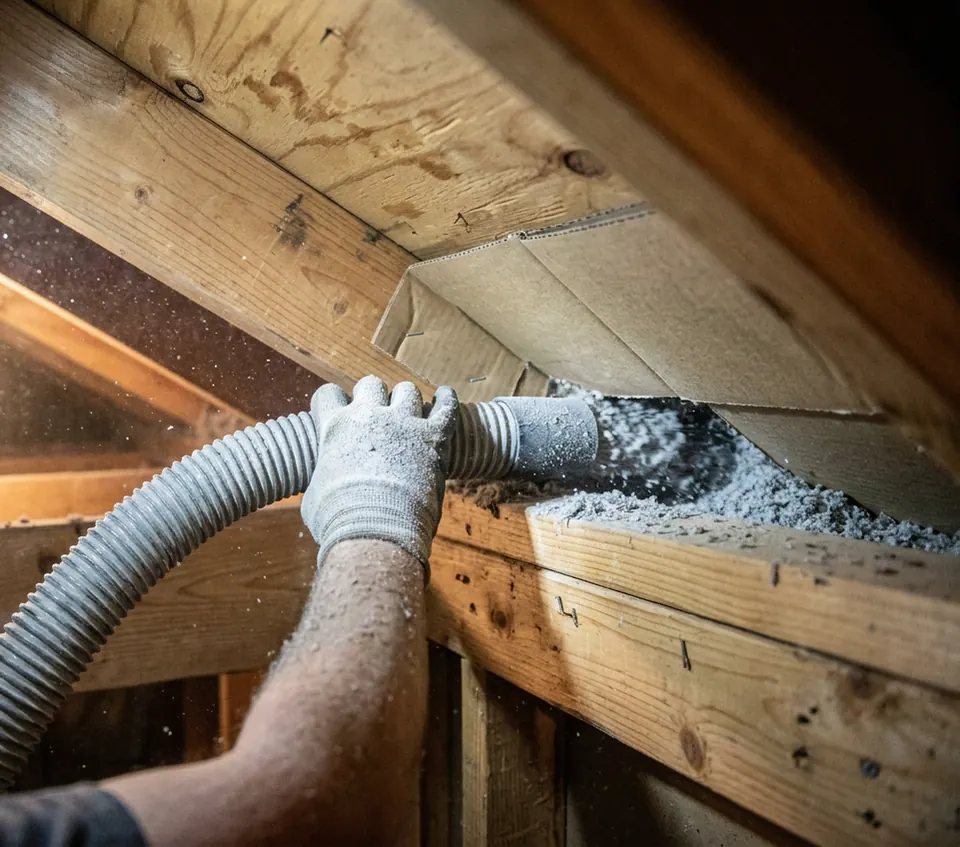
The order matters, because it is the order in which work gets cut when a bid is priced down. Everything above the blowing is preparation, and preparation is invisible from the hatch once the material is in.
- Setup and protection. Ladders, floor and stair protection along the route, a hose run to the attic through a hatch or a gable, and the machine set up and fed. A two-person crew is usually one on the hose and one loading bags, which is why the job is priced in crew-hours rather than in hours.
- Baffles and dams. Soffit vents need baffles before loose fill goes near the eaves, or the material buries the intake and the ventilation path stops working. Flues, chimneys and non-IC-rated recessed fixtures need dams or covers to hold the clearance stated on the fixture's or the flue's own listing label. The National Electrical Code carries a clearance requirement of its own, but it is a model code adopted and amended jurisdiction by jurisdiction, so your local building department is the authority on the edition in force. The hatch needs a dam and weatherstripping.
- Air sealing, if it was bought. Top plates, wiring and plumbing penetrations, bath fan housings and the chimney chase, sealed before they are buried. The Department of Energy treats sealing the ceiling plane as the partner job to insulating it. It is a separate scope with its own hours, it is the line most often left out, and doing it afterwards means moving the material again.
- Depth markers and the written target. Markers placed so the installed depth can be read later, and the target R-value, coverage and bag count recorded. This is what makes the job checkable, and it takes minutes.
- Blowing. The material in, worked to an even depth across the whole floor, including the far corners and over the wall top plates, where depth is hardest to hold.
- Cleanup. Hose and machine out, protection out, spill vacuumed, empty bags counted and removed. The bag count is the receipt for what went in.
A fast job is usually a job that skipped the first four. The crew-hour estimate covers all six steps. So a visit well under it did not do all six. Check three things before you pay the last bill. Baffles, visible in every vented rafter bay, with the material stopped behind them. A dam and weatherstripping at the hatch, or the hole you climbed through is still a hole. And depth markers, read in more than one place, including a corner. Even depth is the whole job.
If the joist tops are showing, the depth is below the joist size, which for dressed lumber under the American Softwood Lumber Standard PS 20, that means under 5.5, 7.25 or 9.25 inches for a 2x6, 2x8 or 2x10. Take the deepest of those, filled level to the top with blown fiberglass at its best 2.7 R per inch. That is only about R-25. It falls short of the ENERGY STAR level for a bare attic in every climate zone. Treat depth as a check on the work, not an exact reading of R-value. Loose-fill R-value does not rise in step with depth, because the material settles and packs itself down.
What the labor line does by state
Labor is the only part of an installation that follows local wages, so it is where geography shows up. The same 1,200 square foot attic, the same 10.8 to 14.4 crew-hours, the same burden range, at the BLS May 2025 mean wage for SOC 47-2131 in seven states chosen to span the national range.
Figures: BLS OEWS May 2025 state average wages, run through the Insulation Report Cost Model, August 2026. The billed-rate and labor columns carry the model's estimated crew hours and wage multiplier, so both are estimates.
| State | BLS mean hourly | Billed crew-hour | Labor only, 1,200 sq ft |
|---|---|---|---|
| West Virginia | $19.62 | $39.24 to $58.86 | $424 to $848 |
| North Carolina | $21.24 | $42.48 to $63.72 | $459 to $918 |
| Texas | $23.97 | $47.94 to $71.91 | $518 to $1,036 |
| Pennsylvania | $26.28 | $52.56 to $78.84 | $568 to $1,135 |
| Rhode Island * | $28.20 | $56.40 to $84.60 | $609 to $1,218 |
| New York | $31.90 | $63.80 to $95.70 | $689 to $1,378 |
| Washington | $37.64 | $75.28 to $112.92 | $813 to $1,626 |
* Derived, not measured: BLS published no SOC 47-2131 wage for this state, so it is scaled from the state's all-construction wage (the fuller note is on the cost hub). The billed rate and labor columns multiply that wage by the burden estimate, so they inherit both caveats.
The labor line very nearly doubles from the bottom of that table to the top. What that does to a finished job, material included, is on the cost hub. You are shopping a labor market, not a material market: a quote from a high-wage state is not automatically padded and one from a low-wage state is not automatically a bargain. When a bid sits far above the band, the wage is rarely the explanation. Scope is.
Below a certain job size the state wage stops mattering at all. That is the more useful thing to know if your attic is small. Take the 400 square foot attic from the table further down. At the low end of the band, the modeled labor is $141 in West Virginia and $271 in Washington. Both sit under the 8 crew-hour minimum charge shown below, which runs $421 to $632 at the national billed rate. Under that floor, the wage has stopped setting the price and the trip has taken over. The whole gap between the cheapest state and the dearest has already been swallowed by the minimum charge. The wage only bites once the attic is big enough to fill the day.
What the exclusions cost in crew time
The cost hub lists what pushes a finished total above the band, including access, contamination and removal. What follows is the same problem seen from the labor side: what each excluded line costs in hours, and why none of them scale with floor area the way the crew-hour estimate does. That is why a bid can be cheaper per square foot and still be dearer per hour of work in your attic.
| Line to ask about | What it costs in crew time, and what "not included" means |
|---|---|
| Air sealing | A separate scope with its own hours, and not inside the 9 to 12 crew-hours modeled here, which cover the blowing visit only. Its hours follow the number of penetrations rather than the floor area: top plates, wiring and plumbing runs, bath fan housings, the chimney chase. Bought afterwards, the hours are paid twice, because the material has to be moved to reach the ceiling plane again. DOE guidance treats sealing as the partner job to insulating |
| Baffles at the eaves | Counted per vented rafter bay, so the hours follow the length of the eaves and the rafter spacing, not the floor area. Laid out square with two vented eaves, the 1,200 square foot reference attic is about 52 bays at 16 inch centers and about 35 at 24 inch centers, each baffle fixed by hand at the lowest and tightest point in the attic. That is why the line is priced per bay and why it is the first thing cut |
| Hatch and knee walls | Hand time, not machine time, so it does not fall with the price of a bag. The hatch needs a dam, a rigid panel and weatherstripping. A knee wall is vertical, so loose fill cannot be blown against it without a backing, and the usual answer is batts sized to the bay, 15 inches wide for framing at 16 inch centers and 23 inches at 24, fitted and held rather than dropped in |
| Recessed-light covers | Priced per fixture, so ask how many you have before comparing two bids. Non-IC-rated fixtures must not be buried: the clearance on the fixture's own listing label governs, and the National Electrical Code carries a clearance requirement too, though it is a model code and your building department is the authority on the edition in force. Without covers or dams you get an unfilled circle around each fixture or a buried one, and the second is a defect |
| A written target R-value and depth markers | Minutes of work, and the only line that makes the rest checkable after the crew has gone. Ask for the target, the coverage per bag at it, the bag count, and markers left in the attic. The FTC R-value Rule (16 CFR Part 460) governs how R-value is stated in the sale of home insulation; the bag count is how you check your own attic |
Removal is not one of those lines. It is a job of its own, with its own crew hours. It gets quoted separately even when the same contractor does both. So settle whether the old material is coming out before an installation quote means anything. Remove or add over runs that decision, and what removal costs prices it.
On targets: ENERGY STAR recommends R-30 for an uninsulated attic in climate zone 1, R-49 in zones 2 and 3, and R-60 in zones 4 through 8, which cover most of the country, with lower figures where 3 to 4 inches already exist. Those recommendations are based on the 2021 IECC model code. Energy codes cover new building and work done under a permit. They do not usually cover adding insulation to an attic you already have. Which edition applies where you live depends on your state, and often on your city. Your local building department is the only authority on it.
Minimum charges, and why a small attic costs more per square foot
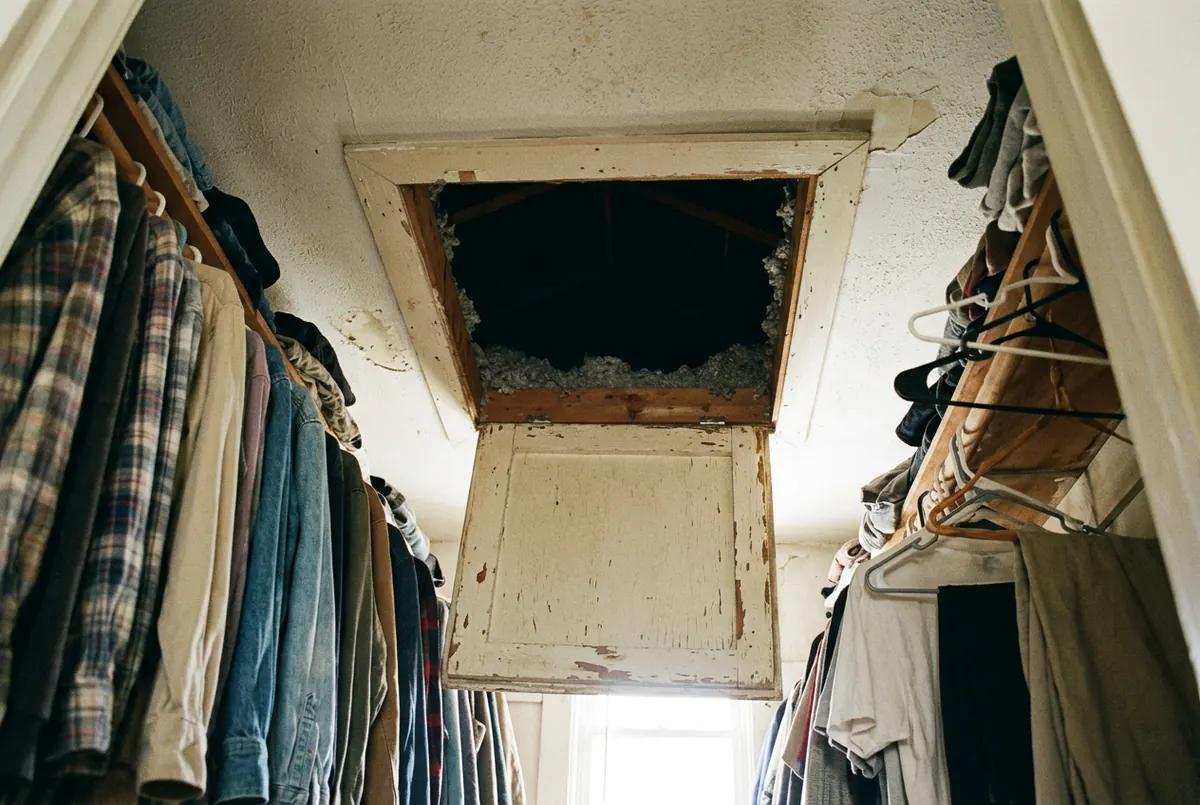
The access decides the setup time
A hatch in a bedroom closet means clearing the closet, masking the room and carrying everything through the house. That cost is the same whether the attic is 600 square feet or 1,600.
The model behind this page scales straight with floor area. So its labor figure per square foot is the same at every size: $0.47 at the low end, whether the attic is 400 square feet or 2,000. For one size priced end to end, material and labor together, see the cost to insulate a 2,000 square foot attic.
Figures: Insulation Report Cost Model, August 2026. Labor only, at the BLS OEWS May 2025 national average wage. The crew hours and the wage multiplier are estimates, so every dollar in this table is an estimate.
| Attic floor area | Crew-hours | Modeled labor only | Labor per sq ft, low |
|---|---|---|---|
| 400 sq ft | 3.6 to 4.8 | $190 to $379 | $0.47 |
| 600 sq ft | 5.4 to 7.2 | $284 to $569 | $0.47 |
| 1,000 sq ft | 9.0 to 12.0 | $474 to $948 | $0.47 |
| 1,500 sq ft | 13.5 to 18.0 | $711 to $1,421 | $0.47 |
| 2,000 sq ft | 18.0 to 24.0 | $948 to $1,895 | $0.47 |
Real quotes do not behave like that at the small end, and the reason is in the first row. A 400 square foot attic models at 3.6 to 4.8 crew-hours, but the costs that come with a visit do not shrink with the attic: the drive out and back, hauling and setting up the machine, protection through the house, the hose run, the trip to the supplier. A crew cannot sell a fraction of a trip.
To see the shape of it, suppose a contractor treats any job as at least half a day for two people, which is 8 crew-hours. At the billed range above, that floor is $421 to $632 of labor, and on a 400 square foot attic the low end alone is $1.05 per square foot against the $0.47 the linear model predicts, more than double. The 8 crew-hours is an illustration, not a measured minimum. Minimum charges vary by contractor and are not measured here. What the arithmetic shows is the direction and rough size of the effect, which is enough to know that a small attic quoted high per square foot is not necessarily being overcharged. Ask what the minimum is, and if you were already planning air sealing or hatch work, bundle it into the same visit rather than paying the trip twice.
Working the labor back out of a quote
You need the quote itemized first: the hub's four-step test sets out what to ask for and judges the total against the installed band. What follows judges the labor inside it, by taking the material out and dividing what is left by the hours.
- Price the material yourself. Bag count times the shelf price of the product quoted. Without a bag count, the attic insulation calculator works it out from floor area and target R-value using published coverage. The contractor buys below shelf, so this number is high on purpose.
- Subtract it. Quote minus material is the implied labor and extras line. Subtract anything named and priced separately, such as air sealing or removal, and what is left is the labor on the insulation itself.
- Divide by the hours. Take your floor area, multiply by 9 to 12 per 1,000 square feet to get the crew-hours, and divide the labor line by them. That is the implied billed crew-hour rate. Compare it with $52.64 to $78.96 nationally, or with your state's row in the table above.
The verdict. An implied rate inside $52.64 to $78.96 means the labor is ordinary and the decision is about written scope rather than price. Two readings are worth acting on:
- An implied crew-hour rate above the band. Ask what buys the extra hours or the extra rate, once, in writing. Hard access, a small attic against a minimum charge, a two-story hose run, knee walls or a high-wage state are all real answers and all show up as hours. An answer that names no work, or no answer, means quote the job again elsewhere.
- An implied rate well below the band. Treat it as a warning rather than a win, because the rate is not what got cut, the hours were. Ask which of the six steps above are in the price and confirm baffles, dams and covers by name. The hours that go first are the preparation nobody can see from the hatch once the material is in.
One caution on the arithmetic: two of its inputs, the burden multiplier and the crew-hour figure, are estimates. The test is good at catching a bid that is far outside the band and bad at splitting hairs between two bids that are both close to it. When both are close, decide on written scope.
Get quotes for attic insulation
Tell us the job and your ZIP. We pass it to a licensed contractor who works in your area.
A marketing service, not a licensed contractor. Insulation work is performed by independent licensed local contractors.
- What happens next?
- Your request goes to a licensed insulation contractor near you, usually within about an hour during the day.
You may not need this
We do not sell insulation and we do not install it, which is why this section is here. Some of the people pricing an installation should not be buying one this year, and on this page the reasons are about hours rather than depth.
- The job is small enough that the minimum charge eats the saving. On a 400 square foot attic, the modeled labor is $190 to $379. Both ends fall below the 8 crew-hour floor priced above. So most of what you pay is the trip, not the work. This is also the one case where doing it yourself closes most of the gap. An attic you can walk in, empty and clean, needing no removal and no air sealing, where the labor line is all there is to save and the machine, the baffles and the heat come with it.
- The ceiling is not air sealed yet. Sealing is a separate scope with its own hours, and it has to happen before the material goes in. Buy the insulation hours first and you buy some of them again, because the material has to be moved to get back to the ceiling plane. Insulation slows conduction and does nothing about air moving through gaps at top plates, wiring penetrations, the chimney chase and the hatch.
- Another trade is booked. Reroofing, rewiring, a bathroom fan or duct work all disturb an attic. Setup, protection and the hose run are paid for on every visit, so insulating before the others finish buys those hours twice and puts the new material under someone else's boots.
- You have not measured what is already up there. An attic close to the ENERGY STAR level for its zone repays more depth slowly, and the hours cost the same either way. The depth checker turns inches into an R-value range, and the cost hub sets out the point at which more depth stops being the right spend.
Related guides
Common questions
How much of an attic insulation quote is labor?
Take the worked case here: a 1,200 square foot attic blown to R-49. Labor, plus everything a contractor carries on top of it, comes to about 22 percent of the modeled low estimate. The rest is material. So install prices move less by region than the labor line suggests. The bags cost the same everywhere, and only the labor slice follows the local wage. Both labor inputs are estimates, not measurements: the crew hours and the multiplier on wages. So treat that split as a rough shape, not an exact share.
Why does a contractor bill $52.64 to $78.96 an hour when the trade wage is $26.32?
Because the wage is what reaches the worker. The billed rate has to carry everything else. Payroll tax, workers compensation at a high rate for attic work, and general liability. Then the truck, the blowing machine, bags, baffles and disposal. Then the hours spent quoting and driving that nobody pays for, plus overhead and profit. Two to three times base wage is the ordinary range in construction. We carry it as a range and label it an estimate, because we have not checked it against real invoices. Any hourly figure built on it carries that same warning.
How long should installing attic insulation take?
The estimate used here is 9 to 12 crew-hours per 1,000 square feet, so a 1,200 square foot attic is 10.8 to 14.4 crew-hours, which for a two-person crew is roughly 5.4 to 7.2 hours on site. That covers the whole visit: protection, baffles, dams, markers, blowing and cleanup, but not air sealing, which is a separate scope. A crew in and out in an hour did not do six things in that hour. The figure is secondary trade guidance, not a primary measurement.
Should I take the cheapest installation quote?
Only after you know why it is cheapest. A labor line well below the band usually means fewer hours in the attic, and the hours that get cut first are the ones you cannot see from the hatch: baffles at the eaves, dams around flues and the hatch, covers over non-IC recessed fixtures, and even depth in the far corners. Those are defects, not savings. Compare two itemized bids on matching scope, and if one is cheaper on the same written scope and the same bag count, that one is genuinely cheaper.
Does the state the installer works in change the labor line much?
Close to a doubling, on the BLS May 2025 mean wage for SOC 47-2131. The same 1,200 square foot attic at the same 10.8 to 14.4 crew-hours models at about $424 of labor at the low end of the band in West Virginia and about $813 in Washington. On a small attic the gap stops mattering: at 400 square feet those same two states model at $141 and $271 of labor at the low end, both under an illustrative half-day minimum charge, so the trip sets the price rather than the wage. What the wage does to a finished total is a smaller effect, and the cost hub works that through.
What should an installation quote say in writing?
Get all of this in writing. Attic floor area in square feet. The target R-value. The product. The bag count, and the coverage per bag at that target. And a plain yes or no on air sealing, baffles, removal and disposal, the hatch, and covers for recessed lights. Ask them to leave depth markers in the attic, so you can check the depth afterward. The R-values on the bag are tested under ASTM C518 and advertised under the FTC R-value Rule (16 CFR Part 460). But neither says a word about whether the crew actually put that depth in your attic.