
Remove the old insulation, or add over it?
By Insulation Report Editorial. Last reviewed August 2026. How we research this.
In brief
Add over it, unless one of five things is true. New insulation goes straight on top of old, and the R-values add up. So tearing out sound material means paying to throw away insulation that still works, then paying again to replace it.
Remove only if the old layer is wet or moldy, fouled by rodents or bats, damaged by fire or smoke, possibly vermiculite holding asbestos, or so packed down and broken up that it has turned to dust. One trap sits outside those five.
If your existing batts are faced and you are adding more batts, the new layer must be unfaced. Two vapor barriers trap water between them. The discretionary case for removing an otherwise sound layer is air sealing, which is far easier on a bare deck and is worth more per dollar than extra depth.
This is the question that decides whether your attic project costs about $2,000 or about $6,000, and contractors have an obvious incentive on one side of it. Here is the test we would apply.
The five-step test
Thin and settled is not the same as spent
Material that has compacted below the joists looks like a removal job and is usually an adding-over job: if it is dry and clean, the new layer goes straight on top.
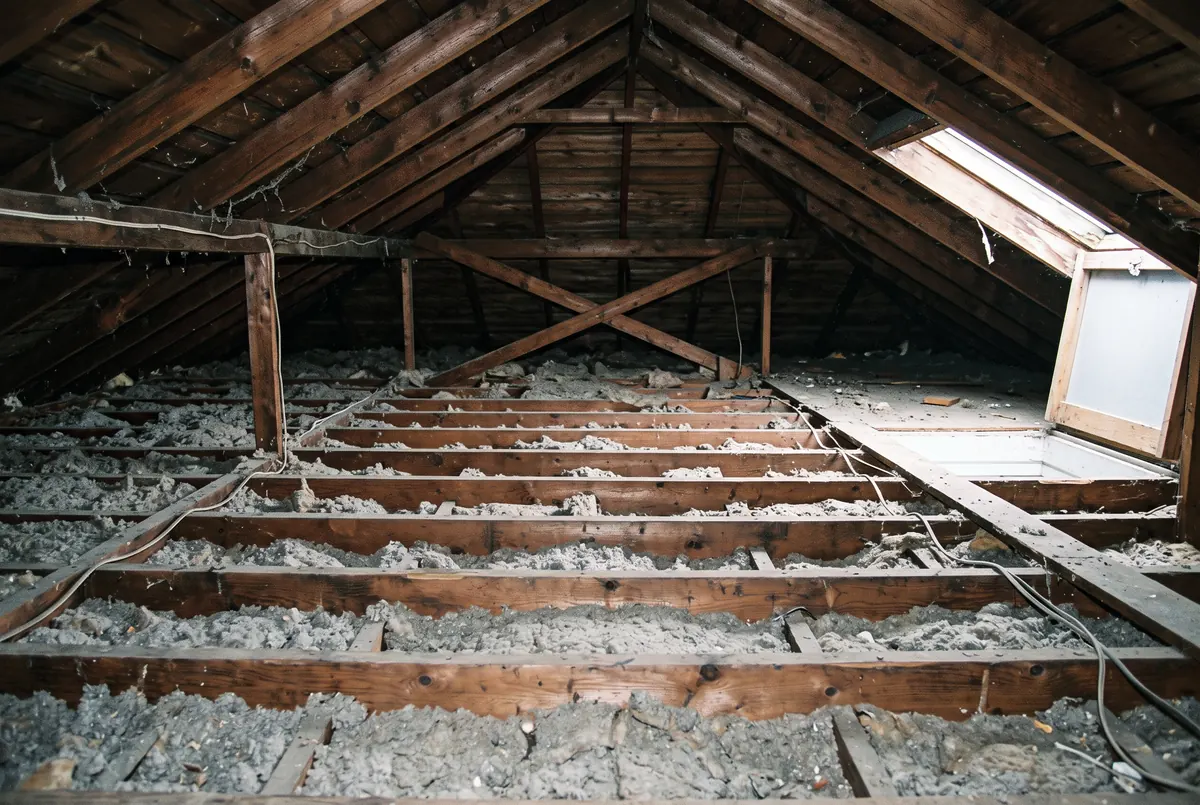
Work down the list. The first "yes" gives you your answer, and you can stop.
| Step | Check | If yes |
|---|---|---|
| 1 | Are there loose granules like small pebbles, grayish-brown or silver-gold, roughly rice-sized? | Stop. Do not disturb it. This may be vermiculite. Read this before touching anything |
| 2 | Are there droppings, nests, tunnels through the loose fill, or a persistent ammonia smell? | Remove. Contamination stays active under a new layer. Rodent contamination |
| 3 | Is the material damp, matted, slumped, stained, or is there a musty smell or visible growth? | Remove, and find the leak first. Mold in attic insulation |
| 4 | Has there been a fire, or does a smoke smell return when the attic heats up? | Remove. Smoke residue is held in loose fill and keeps releasing odor |
| 5 | Is the material crumbling to dust, or compressed to a fraction of its original depth? | Removal is reasonable. Compacted material has lost the trapped air that gave it its R-value. What removal costs per square foot |
| — | None of the above, the layer is just too shallow | Add over it. This is the common case and the cheaper fix. What blown-in insulation costs |
The faced-batt trap
This is the one genuine technical restriction on adding over.
Batt insulation often comes faced, with kraft paper or foil bonded to one side. That facing is a vapor retarder and it belongs on the side of the assembly that is warm in winter, which in a vented attic means facing down toward the living space. If you lay a second faced batt on top of an existing faced batt, you have installed two vapor retarders with insulation between them. Moisture that gets into that sandwich has no easy way out, and it condenses where you cannot see it.
It matters here for one reason. It is the only technical case where a sound layer needs handling rather than just covering. So it belongs in the decision, but it does not change the answer. That is still add over, using unfaced material for the new layer. Insulating over existing insulation covers each case, including batts you have already bought, plus leveling, mixing materials and depth.
What each path costs
Method: ranges below are compiled from contractor-published price ranges current in 2026, on a 1,200 square foot attic, and are typical ranges rather than quotes. Regional labor rates move these more than any other factor.
| Path | Typical total | What you get |
|---|---|---|
| Add over: blow new loose fill on top | $1,700 to $3,000 | Existing R-value plus the new layer. No disruption, one day |
| Add over, with targeted air sealing | $2,300 to $4,000 | The above, plus sealing at the accessible penetrations. Usually the best value |
| Remove, air seal, replace | $4,200 to $7,800 | A bare deck sealed properly, then new insulation to a verified depth |
| Remove contaminated, treat, replace | $5,500 to $10,000+ | The above plus bagging, disposal and deck treatment |
The gap between row two and row three is roughly $2,000 to $4,000. That is the money the decision is actually about, and it is why the five-step test is worth running honestly before anyone quotes you.
The one good discretionary reason to remove
Air sealing. Insulation slows heat conduction, but it does very little to stop air moving through gaps in the ceiling plane, and in most houses a meaningful share of the heat loss is air movement rather than conduction. The places that leak are top plates, wiring and plumbing penetrations, chases around chimneys and ducts, recessed light housings, and the attic hatch itself.
All of those are easy to find and seal on a bare deck, and awkward or impossible under a foot of loose fill. So the honest version of the trade-off is:
- The old layer is shallow, say under four inches, and you are disturbing it anyway. Clearing it out so you can seal properly often pays for itself. You were not keeping much R-value either way.
- The old layer is deep and sound. Taking it out just to seal is usually not worth the cost. Seal what you can reach, then add depth on top.
Not sure which your attic needs?
Describe what you are seeing and give us your ZIP. A licensed contractor in your area can look at it and tell you.
A marketing service, not a licensed contractor. Insulation work is performed by independent licensed local contractors.
- What happens next?
- Your request goes to a licensed insulation contractor near you, usually within about an hour during the day.
How to check your own attic in ten minutes
What adding over actually looks like
The old layer stays where it is and keeps working. New material goes on top until the total reaches the target, which is why removal is the exception rather than the default.
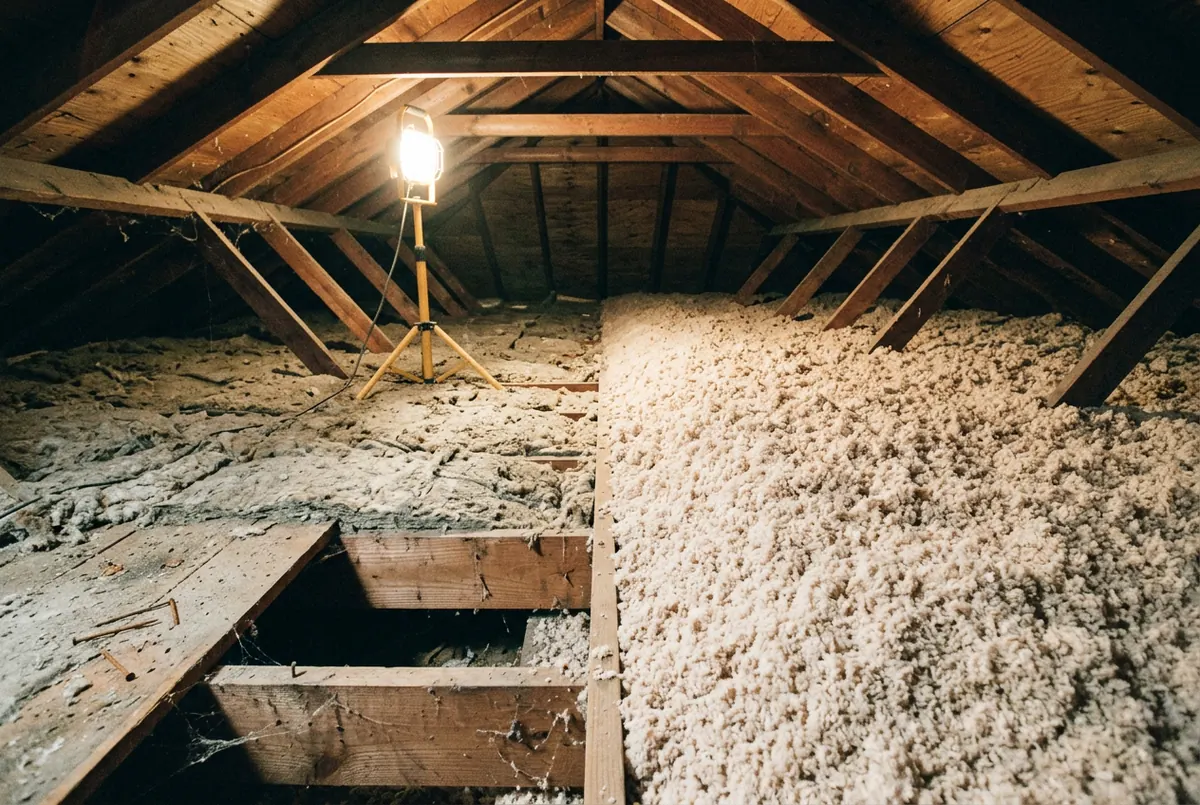
This is the short version, aimed only at the five signals above. For a full survey of an attic whose history you do not know, including what each finding means and when a paid inspection earns its money, see how to inspect an attic.
- Wear protection. A fitted respirator, goggles, gloves, long sleeves. Do not skip this to "just have a quick look".
- Take a bright torch and look across the surface at a low angle. Tunnels, trails and droppings show up in raking light far better than from directly above.
- Measure the depth in at least five places with a ruler pushed down to the drywall, spread across the floor and away from the hatch. Plan from the typical reading, not the deepest. A much shallower spot is a levelling job rather than a lower starting number.
- Look at the underside of the roof deck for dark staining, which indicates a leak or a ventilation problem.
- Smell. Musty means moisture. Ammonia means animals.
- Look at the material itself. Fluffy pink or yellow is fiberglass. Gray-brown shredded paper is cellulose. Loose rice-sized pebbles are the one that means stop.
- Photograph everything, including the depth measurement against the ruler. It makes quotes far easier to compare.
If you find nothing in steps two, four, five and six, and the only issue is that step three came up shallow, you are in the common case: work out the R-value your climate zone calls for and add over the top. Insulating over existing insulation covers how to do that without wrecking the layer underneath, starting with the facing rule above.
Related
Common questions
Can you put new insulation over old insulation?
Yes, in most cases. Department of Energy guidance is that new insulation can be added over existing material and the R-values add together, provided the existing layer is dry, uncontaminated and not badly compressed. The main restriction is that the new layer must not be faced if the existing layer already has a vapor retarder facing.
Does old insulation lose its R-value over time?
Fiberglass and mineral wool hold their rated value almost indefinitely if they stay dry and undisturbed. Loose-fill cellulose settles, typically losing some of its installed depth in the first years, and depth is what carries R-value. Any insulation that has been wet, compressed by storage, or flattened by foot traffic has lost performance that it will not recover.
How do I know if my attic insulation is bad?
Look for four things: staining or matting that indicates water, droppings or tunnelling that indicate rodents, a musty smell that indicates mold, and pebble-like granules that may be vermiculite. If none of those are present and the material is simply shallow, it is not bad insulation. It is insufficient insulation, which is a different and cheaper problem.
Is it worth removing insulation just to air seal?
Sometimes, and it is the most defensible discretionary reason to remove. Air sealing the ceiling plane is far more effective per dollar than added depth, and it is only straightforward when the deck is bare. If your attic is shallow and you were going to disturb it anyway, clearing it to seal properly can be worth the extra cost. If the existing layer is deep and sound, targeted sealing around the accessible penetrations usually captures most of the benefit.