
Frost in the attic: the moisture is coming from the house, not the weather
By Insulation Report Editorial. Last reviewed August 2026. How we research this.
In brief
Frost in an attic is house air, not weather. Warm indoor air leaks upward through gaps in the ceiling, carrying water vapor with it, and that vapor condenses and freezes on the coldest surfaces it finds.
Steel sheds heat far faster than wood, so the roofing nail tips poking through the sheathing frost over first, which is why rows of white nail points are the most common sighting. The fix is sealing the ceiling plane below, not adding vents above: on a leaky ceiling, extra exhaust venting can pull more indoor air up through the gaps.
Light nail-tip frost that melts and dries by mid-morning, with no staining on the wood, usually needs nothing beyond winter humidity management. Frost patches above a bathroom or kitchen point to one fixable leak. Widespread frost across the sheathing, with staining or dark shadowing, means the ceiling is leaking at scale and is worth a professional air sealing job.
Why frost forms in an attic at all
Why the nail tips go white first
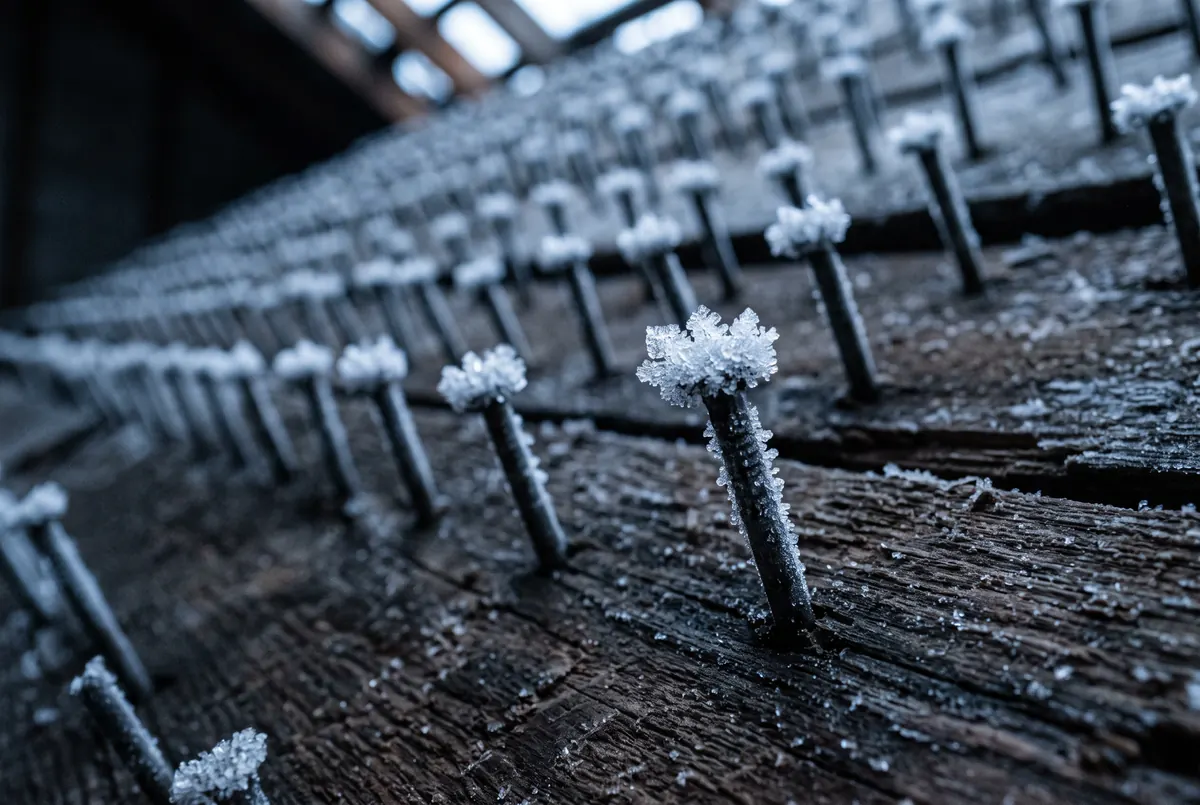
Steel conducts, so the nail points are the coldest surfaces in the attic and the moisture in escaping house air freezes on them before it reaches anything else.
A vented attic in winter runs close to outdoor temperature. That is by design: the vents keep the roof cold so snow does not melt and refreeze at the eaves. The house below it, meanwhile, is warm and holds far more water vapor, from cooking, showers, laundry, houseplants, humidifiers and the people breathing in it.
Only your ceiling separates those two bodies of air, and no ceiling is perfectly sealed. Warm air rises. So in cold weather the top of your house is under slight pressure, and air pushes up through every gap it can find. The attic hatch, the bath fan housing, recessed lights, plumbing stacks, wiring holes, and the joints where walls meet the ceiling. The U.S. Department of Energy's Building America Solution Center describes attic condensation in exactly those terms. Warm damp air escapes the house into the attic, and the water vapor in it condenses on cold surfaces like the trusses and the underside of the roof sheathing.
When those surfaces are below freezing, the condensation skips the liquid stage and deposits directly as frost. The attic is not wet because water got in from outside. It is wet because your own household air got out, upward, and met a surface cold enough to wring the vapor out of it.
Geography sets the odds. Attic frost is overwhelmingly a cold-climate pattern, IECC climate zones 5 through 8. That band runs from the lower Midwest up through Minnesota, northern New England and interior Alaska. It needs sheathing held well below freezing for days. In zones 1 through 3 the same ceiling leaks show up as summer humidity problems instead, which is the same defect wearing a different season.
Frost on the roof nails: why the nail tips frost first
The classic first sighting is frost on the nail tips: hundreds of roofing nails poking through the underside of the sheathing, each wearing a white cap, in neat rows tracing the shingle courses above. There is a plain physical reason they go first.
A steel nail conducts heat far better than the wood around it. Its head sits just under the shingles, effectively outdoors, so on a cold night the whole shank runs at close to outdoor temperature while the wood face beside it lags slightly behind. The nail tip is therefore the coldest exposed point in the attic, and the first surface to fall below the frost point of the attic air. It is a grid of several hundred small cold probes, and moist air touching any of them gives up its vapor there first.
This is worth knowing because it sets the severity scale. Nail tips frost at a lower moisture load than anything else. Frost confined to the nails means the attic air is only slightly too moist. Frost spreading onto the sheathing between the nails means the moisture load is high enough to chill and saturate the air at the wood face itself, which takes a much bigger leak, and that distinction drives the diagnostic below.
The diagnostic: three findings, three verdicts
Go up on a cold morning, after at least a couple of days below freezing, with a torch and without stepping off the framing. Look at the underside of the roof deck, slope by slope, north side especially, and match what you see to one of the three findings below. Each one ends in a verdict, not a shrug.
Finding 1: light frost on the nail tips only, gone by mid-morning
The nails wear small white caps, the sheathing between them is clean and dry, and when the sun comes up the frost melts and the wood dries the same day. No staining, no rust rings, no damp insulation, no smell.
Verdict: this often needs no contractor and no project. A light nail-tip frosting during a hard snap is the attic telling you the moisture margin is thin, not that it has been crossed. The proportionate response is on the humidity side: turn the humidifier down, run the bath fans longer, and check again on the next cold morning. We do not sell insulation and we do not install it, so nothing on this page needs you to buy anything, and the honest reading of this finding is that most attics showing it are fine. Watch it once or twice each winter and act only if it escalates to the findings below.
Finding 2: frost patches on the sheathing above a bathroom or kitchen
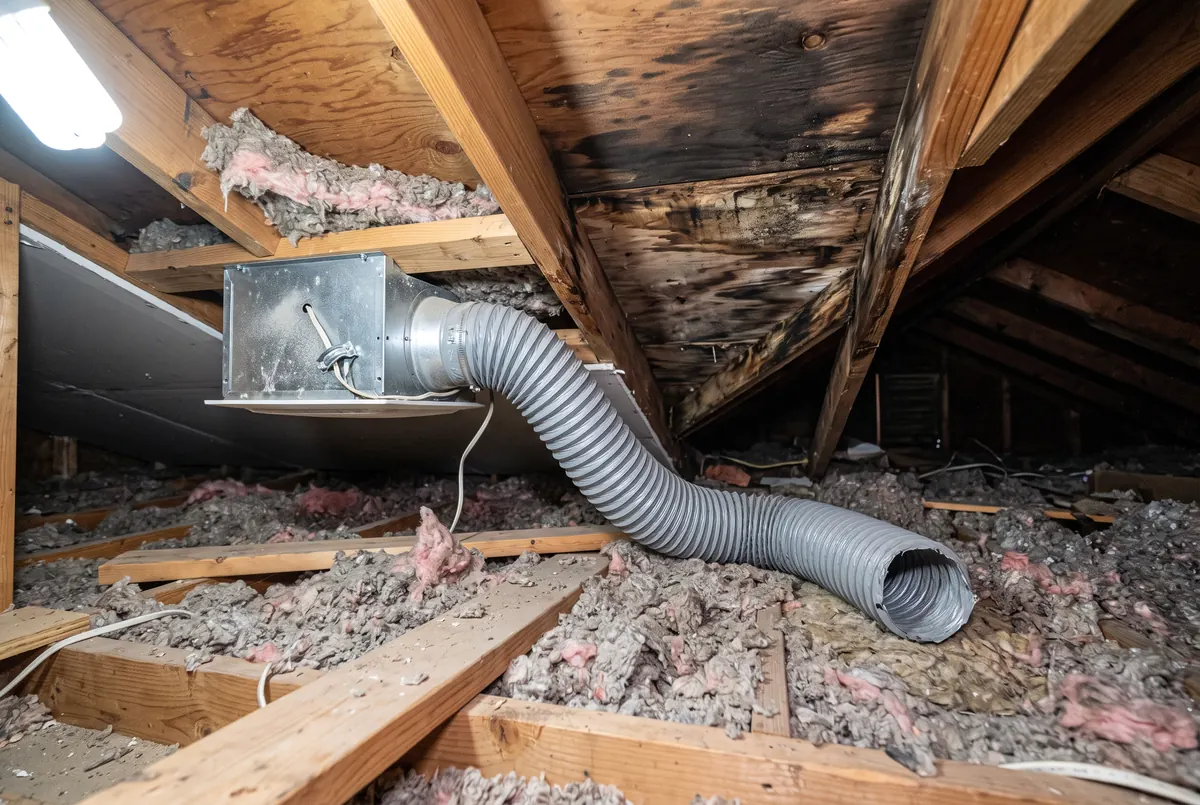
Clear patches of frost on the deck, usually right above the rooms that make the moisture. The bathroom. The kitchen. Sometimes the laundry. There is often a matching clue underneath. A bath fan duct that has come loose and is blowing shower air straight into the attic. A fan that vents into the attic on purpose, which is never acceptable. A bare hatch. Or open chases above interior walls.
Verdict: find and seal the specific leak, which is usually a DIY weekend. Localized frost means a localized leak, and the shortlist is short: the bath fan duct and housing, the hatch, the top plates of the walls below the frost, and any plumbing or wiring penetrations in that zone. Reconnect and seal the fan duct so it terminates outside, weather strip and insulate the hatch, and foam or caulk the penetrations. The air sealing guide covers the how for each leak type, and the gear list covers the sealant, foam and protective kit the job takes.
Finding 3: widespread frost, staining, dark shadows or delamination
Frost across large areas of sheathing on more than one slope. Rust rings around the nails, brown drip staining, or gray or black shadowing on the wood. Sheathing plies starting to separate, or insulation that is matted and damp. Any one of these means the melt cycles have been running for a while, and the wood is not drying fast enough between them.
Verdict: your ceiling is leaking badly, and the fix is professional air sealing before any insulation work. At this stage it is not one bad duct. It is dozens of paths adding up. Sealing them properly means pulling insulation back to reach the tops of walls and the holes across the whole floor. Adding insulation over an unsealed ceiling would hide the evidence and change nothing, because ordinary insulation does not stop moving air. If the dark shadowing has already turned into growth you can see, read mold in attic insulation before anyone quotes you for removal, because the leak has to be fixed first or the mold returns.
Where the moisture is getting in
The Building America Solution Center's guide to sealing ceilings under vented attics lists the usual paths. Attic hatches and pull-down stairs, bathroom fans, recessed ceiling lights and electrical boxes. Plumbing stacks, chimneys, wiring holes, duct chases and dropped soffits. And the top of every interior and exterior wall. Ranked by how much damp air they tend to move, here are the ones to check first:
- A bath fan ducted into the attic, or a disconnected fan duct. This is a hose pointed at the roof deck, delivering shower-saturated air by the fanful.
- Open chases and dropped soffits. Framing cavities that run from the basement or interior walls straight into the attic, sometimes palm-sized or larger.
- The attic hatch or pull-down stair. A large, badly fitted panel, often with no weather strip and no insulation.
- Recessed lights and ceiling electrical boxes. Small individually, numerous collectively, and warm, which drives flow.
- Top plates, plumbing stacks and wiring penetrations. The long tail. Dozens of small gaps that in total can outleak the hatch.
The air sealing guide walks through finding and sealing each of these, in order. And the frost has already done half that work for you. The pattern on the deck is a map of where the leaks below are worst.
The humidity side of the equation
Leak area is one factor. The other is how much vapor the escaping air carries, which is set by indoor humidity. The same ceiling that frosts an attic at high indoor humidity may be harmless in a drier house. Building America guidance notes that most sources recommend keeping indoor relative humidity between 30 and 50 percent during the heating season. Building Science Corporation's attic ventilation digest deals with cold-climate attic moisture specifically. It works with humidity held below 45 percent in the coldest months, which is the stricter end of the same range.
Practical levers, in the order they usually matter:
- Humidifier setting. If a whole-house or portable humidifier is running, it is feeding the frost directly. Turn it down in cold snaps, and let a cheap hygrometer, not comfort intuition, decide the setting.
- Bath fan runtime. Run the fan for the whole shower and keep it running until the mirror and walls have fully cleared, not just until you leave the room. A timer switch makes this automatic.
- Kitchen habits. Lids on pots, and the range hood running while you cook, if it vents outside.
- The obvious loads. Firewood drying indoors, an unvented dryer, dozens of houseplants, an uncovered crawl space sending ground moisture up through the house. Each raises the humidity every leak carries upward.
Watch condensation on the bottom corners of your windows as a rough live gauge. If the glass is streaming in ordinary winter weather, the attic nails are almost certainly frosting too.
What the fix costs, and which line has no number
Figures: Insulation Report Cost Model, August 2026, where a figure exists. This site publishes no price for professional air sealing as a stand-alone job, because it holds no sourced figure for one, and the honest table says so instead of inventing a row.
| Fix | Who does it | Cost |
|---|---|---|
| Air sealing the ceiling plane, verdict 2 scale | You | A few tubes of caulk and cans of foam; the materials list is short |
| Air sealing at scale, verdict 3 | Contractor | No published figure here. Get it itemized in the insulation quote, line by line |
| Insulation top-up to the zone target, after sealing | Contractor | About $2,622 to $3,190 installed to R-49 on 1,200 sq ft. Estimate |
Get quotes for attic air sealing
Widespread frost is an air sealing job before it is an insulation job. Tell us what you found and your ZIP, and we pass it to a licensed contractor in your area who can quote sealing the ceiling plane properly.
A marketing service, not a licensed contractor. Insulation work is performed by independent licensed local contractors.
- What happens next?
- Your request goes to a licensed insulation contractor near you, usually within about an hour during the day.
The correction: more ventilation is usually the wrong fix
The intuitive response to a damp attic is more vents, and it is the one thing every roofing forum will suggest. For frost, it aims at the wrong end of the problem. The moisture is not failing to leave the attic. It is arriving from the house faster than any realistic airflow can carry it away, and it freezes to the deck on contact, where no amount of ventilation can touch it until it melts.
It can be worse than useless. Building scientist Joseph Lstiburek's rules for vented roofs warn about what happens above a leaky ceiling. Too much exhaust, ridge vents with no matching intake, turbine vents and powered attic fans can all pull their replacement air from the house below instead of from the soffits. That drags more warm damp air up through the gaps in your ceiling. Drop the pressure in a leaky attic and you have built a machine for watering your own roof deck. The Building America condensation guidance draws the same line. It lists two controls for attic condensation: cut the air leaking out of the house, and cut the humidity inside it. Balanced intake and exhaust venting is a supporting measure there, not the cure.
Ventilation still matters. A properly vented attic dries faster after the leaks are sealed, and blocked soffits or missing baffles are worth fixing on their own merits. The ventilation guide covers sizing and balance, and the attic fan page covers why powered exhaust above a leaky ceiling causes precisely the problem this page is about. The order is the point: seal, then verify humidity, then tune ventilation. Venting first is treating the puddle and ignoring the tap.
Frost is seasonal evidence, use it while it lasts
A blower door test in July can tell you your ceiling leaks and roughly how much. Frost in January tells you the same thing for free, and adds the one thing the blower door cannot: a map. Every frosted patch sits above a leak, every clean slope above tight ceiling. Before it melts, photograph each slope from the hatch, note which rooms sit under the worst patches, and you have a targeted work list for spring instead of a guess.
The same escaping heat that frosts the deck also melts the snow above it. That is why houses with attic frost so often grow icicles too. If your eaves build ice ridges in the same winters the nails frost, both symptoms have one cause and one fix, covered in the ice dam guide. The cold-morning inspection may turn up other question marks, such as low insulation, dark-stained fiberglass, or daylight where there should be none. The attic inspection guide covers reading the whole space, season by season.
The single largest moisture source people find up there
A bath fan discharging into the attic instead of outdoors puts warm wet air directly against the cold deck, every shower, all winter.
Common questions
Is frost in the attic normal?
Light, temporary frost on the tips of the roofing nails during a hard cold snap is common in cold climates and often harmless. Every house leaks some air through its ceiling, and nail points are the coldest surfaces in the attic, so they frost first. It becomes a problem when frost spreads onto the roof sheathing itself, keeps coming back, or leaves water stains, dark patches or damp insulation behind when it melts.
Will attic frost go away on its own?
The frost itself will, every time the weather warms, which is exactly why the underlying problem gets ignored. The moisture source does not go away. Indoor air keeps leaking through the same ceiling gaps every winter, and each melt cycle wets the sheathing again. One light frosting a winter that dries fast is tolerable. Repeated cycles are how sheathing stains, grows mold and eventually delaminates.
Does frost in the attic mean I have mold?
Not by itself. Frost is frozen condensation. If it dries quickly after each melt, there may be no growth at all. Mold needs the wood to stay damp. So the tell is what the sheathing looks like in summer. Clean wood means the attic is drying. Gray or black shadowing means the melt water has been sitting long enough to feed growth. Look on the north slope and around the nail tips first. And OSB sheathing takes fewer wet cycles than plywood before its edges swell, so on newer roofs the margin is thinner.
How do I tell a roof leak from melted frost?
Pattern and timing. A roof leak tracks a fixed entry point, so the stain sits under one spot, often below a penetration such as a vent boot or chimney, and it appears after rain. Frost melt is diffuse and shows up as scattered drips, damp insulation, or staining spread across a slope, and it appears during a thaw after a cold spell, on days when it has not rained at all. Frost melt also favors nail lines, leaving rows of small rust-ringed dots.
Should I add ventilation to stop attic frost?
Usually no, and it can backfire. Frost means indoor air is reaching the attic through ceiling leaks. Building America guidance treats sealing that leakage as the primary control, with ventilation as the supporting measure. Adding exhaust vents or a powered fan above a leaky ceiling can pull more house air up through the gaps, which adds moisture faster. Seal the ceiling plane first, then check that the existing vents are clear and balanced.
Will more insulation stop attic frost?
No. Standard blown or batt insulation is air-permeable, so moist house air passes straight through it, and a deeper blanket actually makes the attic colder, which can make condensation slightly worse. Insulation controls heat flow, not airflow. The frost stops when the air leaks are sealed. Sealing and then topping up insulation is the right order, and it is the order Building America guidance specifies.