
What the internet gets wrong about insulation
By Insulation Report Editorial. Last reviewed 2026-08-09. How we research this.
In brief
This page is a numbered list of insulation claims that get repeated everywhere and are wrong. Each entry does four things. It states the claim the way it usually appears. It says what the original source actually says. It names that source. And it gives the date we last checked.
Each one has its own link, so you can cite it on its own. Two of these cost homeowners real money. First, the federal Section 25C tax credit no longer covers insulation. The law, 26 U.S.C. 25C(i), as changed by Public Law 119-21, ends it for anything put in service after December 31, 2025.
Second, no building code makes you put R-60 in an attic you are topping up by choice. Energy codes cover new work and permitted work. And most states never adopted the 2021 edition that number comes from. One entry on this list is our own mistake, dated and explained.
Each entry links to the page here that covers the topic in full. That way the argument sits
in one place and this stays a list. The links (#entry-1 through
#entry-8) will not move. The rest of our reference material is in
the data section. If an entry here is itself wrong, write to the
address at the foot of the page. The fix will carry a date, not happen quietly.
1. "Insulation qualifies for a 30 percent federal tax credit"
What gets published: insulation and air sealing earn the Section 25C Energy Efficient Home Improvement Credit. That is 30 percent of the cost, up to $1,200 a year.
What the source says: that was true through 2025. It is not true now. The law, 26 U.S.C. 25C(i) as changed by Public Law 119-21, section 70505, says this: "This section shall not apply with respect to any property placed in service after December 31, 2025." The IRS page says the same. The credit only covers work put in service before that cutoff. Insulation put in during 2026 earns no Section 25C credit, no matter what a cost page from 2024 promises.
What is still live are the Home Energy Rebates from the Inflation Reduction Act. States run those. The two programs are HOMES and HEAR, and insulation and air sealing count under both. What you can get changes by state. Programs open, close and run out of money, and some have waiting lists. So the only current answer comes from your own State Energy Office. We print no rebate amounts here, because a saved amount goes stale in weeks. The cost hub shows what to check, in order.
Source: 26 U.S.C. 25C(i), as amended by P.L. 119-21 §70505, read at uscode.house.gov; IRS, Energy Efficient Home Improvement Credit page (the 30 percent rate and $1,200 annual limit above are its figures). Last verified: 2026-08-09.
2. "Code requires R-60 in your attic"
What gets published: building code requires R-49 or R-60 in an attic, so an attic below that number breaks the code.
What the source says: the correction has two parts. The first is scope. Energy codes cover new building and work done under a permit. They do not usually cover adding insulation to an attic you already have. Which edition applies where you live depends on your state, and often on your city. Your local building department is the only authority on it.
The second is the number. That R-60 comes from the 2021 IECC, Table R402.1.3. It is the lowest attic value that model code sets for climate zones 4 through 8. And most states never adopted that edition. Reading each state by its newest adopted code, 12 of 51 places (the 50 states plus the District of Columbia) are on the 2021 IECC or newer. And 8 have no statewide home energy code at all. The full state table is at the energy code tracker. It counts the same way, from the same data.
For a bare attic in zones 4 through 8, R-60 is a sound recommendation, and ENERGY STAR makes it. Where 3 to 4 inches are already down, the number is R-49. But recommended and required are two different claims. A page that blurs them turns advice into a law that does not exist.
Source: model figure, 2021 IECC Table R402.1.3 (ICC); state adoption, ACEEE State Policy Database, reviewed November 2024, a secondary source and flagged as such; counts computed from this site's state table at build time. Last verified: 2026-08-09.
3. "A radiant barrier adds R-value"
What gets published: a foil radiant barrier is worth R-19 or more, and you can count it toward your insulation target.
What the source says: A radiant barrier reflects radiant heat rather than resisting conduction, so it has no useful R-value per inch and cannot be counted toward an R-value target. It is measured differently from bulk insulation and the two do not add together. The Department of Energy's Building America guidance says a radiant barrier works by cutting radiant heat gain. It works better in hot climates than cool ones. DOE cites studies showing a 5 to 10 percent drop in cooling costs in a warm, sunny climate. It also notes that dust on the shiny face makes it work worse. The property you measure is emittance, not R-value, under standards such as ASTM C1371.
This is a real product with a real but narrow job. It just gets sold with a number it cannot carry. The radiant barrier page works through when it is worth fitting and when it is not.
Source: DOE Building America Solution Center, "Attic Radiant Barriers" (basc.pnnl.gov). The Energy Saver "Radiant Barriers" page carried the same guidance but its URL returned not-found when re-checked, which is itself a reminder that sources move. Last verified: 2026-08-09.
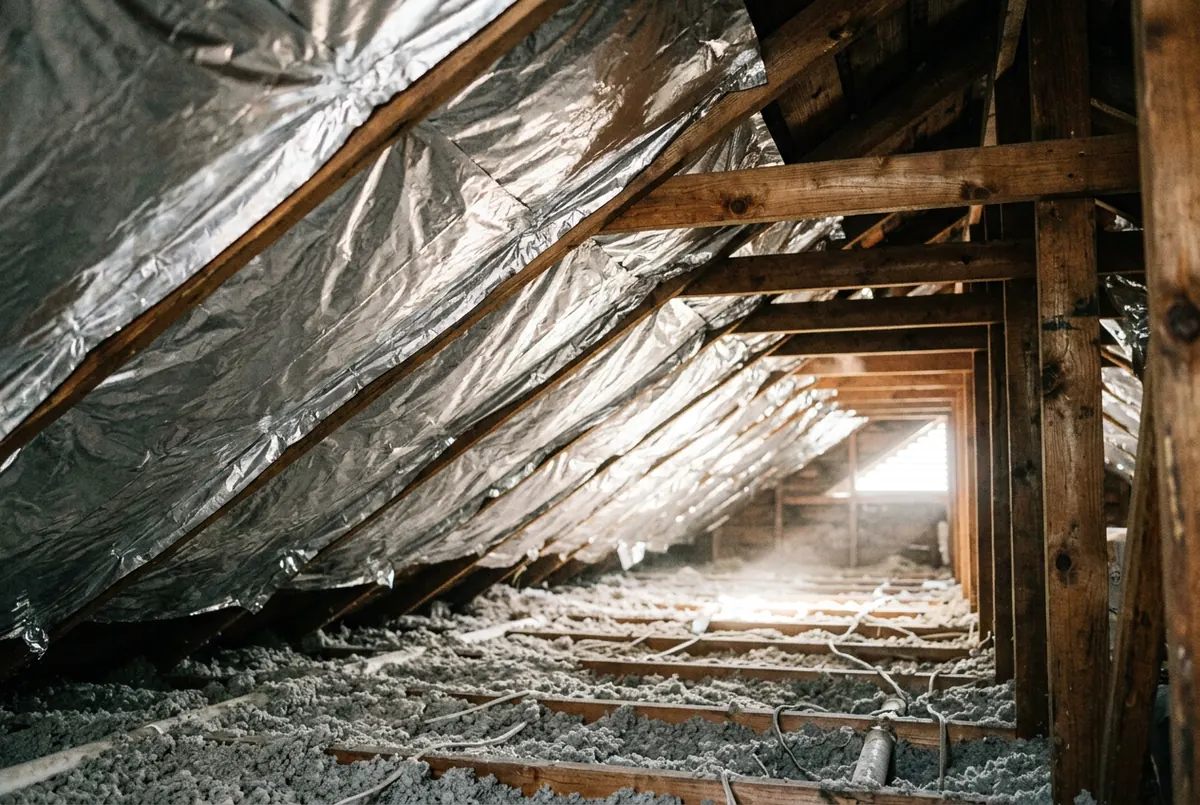
A radiant barrier is a surface, not a thickness
It works by reflecting radiant heat across an air gap, which is why it has no R-per-inch to add to anything. Stapled to the rafters it does a real job; it is just not the job an R-value describes.
4. "Blown-in R-value scales linearly with depth"
What gets published: multiply the depth by a fixed R-per-inch. So twice the depth of loose fill gives you twice the R-value.
What the source says: loose fill packs down under its own weight. Pile it deeper and the bottom gets denser, so each extra inch is worth a little less than the last. The maker's own coverage chart shows this. For Owens Corning AttiCat blown-in fiberglass, 27.5 lb bag, R-value times coverage per bag drops as the target goes up:
| Labeled target | Coverage, sq ft per bag | R × coverage per bag |
|---|---|---|
| R-19 | 110.7 | 2,103 |
| R-30 | 68.5 | 2,055 |
| R-49 | 39.5 | 1,936 |
| R-60 | 31.8 | 1,908 |
If R-value tracked depth cleanly, that last column would be flat. It is not. It falls from 2,103 at R-19 to 1,936 at R-49. That drop is the packing-down DOE describes, printed in the maker's own numbers. So a calculator that divides a target R by a fixed R-per-inch claims more from a bag than the bag gives. The label on the product you actually buy is the one to trust. Our calculator reads the published chart instead.
Source: manufacturer coverage chart as published on the retail listing, read 2026-08-07 and recorded in this site's reference data; DOE notes the underlying settling behavior. Last verified: 2026-08-09.
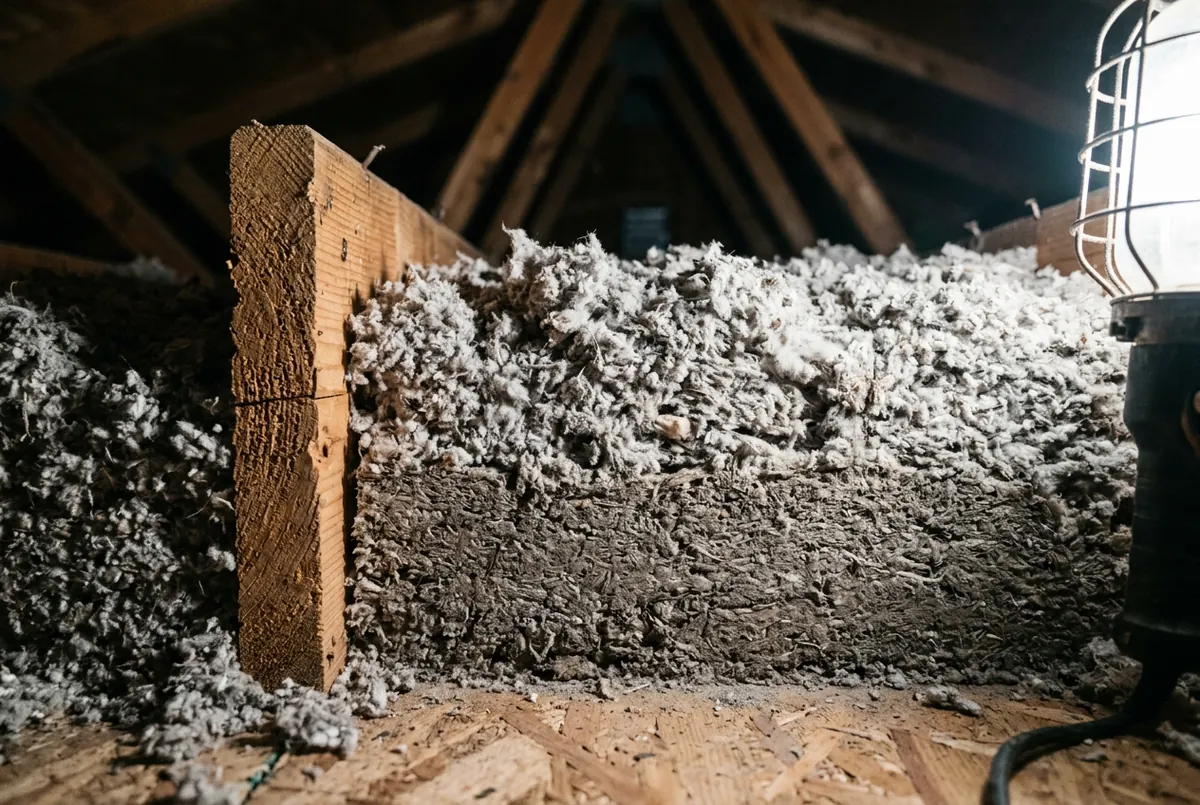
The same material, two densities, one pile
Cut through settled loose fill and the lower band is visibly denser than the top. That is the whole reason depth times a fixed R-per-inch overstates what is actually up there.
5. "Ice dams and a hot house mean the attic needs more ventilation"
What gets published: ice at the roof edge, or a hot upstairs, means the attic needs more air. So the fix is more vents.
What the source says: venting is the third step, not the first. The DOE Building America Solution Center lists the ice dam fixes in order. Seal the ceiling first. Then insulate the attic well. Then vent the roof. Here is DOE's own emphasis: "The most important step is to seal all of the air leaks from the conditioned space into the attic space to keep warm air from entering the attic in the first place." An ice dam is your house heat reaching the roof. Venting only waters down heat that sealing and depth should have stopped.
The same order answers the hot upstairs. Your rooms feel the ceiling under the attic, not the attic air itself. The ice dam guide covers the winter case. The air sealing section covers the first step. And the ventilation hub covers what venting is really for.
Source: DOE Building America Solution Center (PNNL), "Attic Air Sealing, Insulating, and Ventilating for Ice Dam Prevention". Last verified: 2026-08-09.
6. "A powered attic fan lowers cooling bills"
What gets published: a powered attic fan blows hot attic air out, so it cuts your cooling bill and pays for itself.
What the source says: a fan pushes air out. New air has to come in somewhere, and it comes through whichever opening is easiest. Most attics that get one of these fans are short on intake at the roof edge. So the easiest opening is the leaky ceiling below. The fan pulls air you already paid to cool up out of your house, along with moisture from cooking and showers. And the motor uses power on top of that. It can also fight the draft of a gas or oil appliance that vents naturally. That is a safety problem, not a comfort one.
There is a small set of houses where the fan makes sense. The attic fans page works through that case in full, including the intake math. For most attics, our advice is to skip the fan and spend the money on sealing and depth. We do not sell insulation and we do not install it. That is why this page can tell you to keep your money.
Source: DOE Building America Solution Center, "Attic Ventilation Fans" (basc.pnnl.gov), which states that a powered ventilator draws conditioned air from the living space into the attic and that naturally drafting combustion appliances may not draft as well or could backdraft. Last verified: 2026-08-09.
7. "Vermiculite is only a problem if the bag said Zonolite"
What gets published: vermiculite attic insulation is safe unless it is the Zonolite brand, because Zonolite is the contaminated one.
What the source says: the EPA ignores the brand, and it is blunt. One mine near Libby, Montana supplied over 70 percent of all vermiculite sold in the United States between 1919 and 1990. That mine had asbestos in it, so its ore was contaminated. Libby material was often sold as Zonolite, but not always. And you cannot tell contaminated from clean by looking. Here is the EPA's instruction, in its own capitals: "YOU SHOULD ASSUME THE VERMICULITE CONTAINS ASBESTOS AND DO NOT DISTURB IT!" It also says not to try removing it yourself, and to hire a professional asbestos contractor for any work that would stir it up.
Loose attic vermiculite with no brand name on it anywhere gets the same treatment as a marked Zonolite bag. Leave it alone and have a pro look at it. The vermiculite page covers how to spot it and what happens next. It carries no quote form, because insulation contractors are not asbestos removal contractors.
Source: U.S. Environmental Protection Agency, "Protect Your Family from Asbestos-Contaminated Vermiculite Insulation". Last verified: 2026-08-09.
8. The one we got wrong ourselves
What we published, in our own reference data: that installed blown-in cost varies "about 7 percent" from state to state. That came from eyeballing four states in the middle of the table on 2026-08-07, while the cost model was still being built.
What the data actually says: the fair comparison runs lowest state to highest. May 2025 BLS wage data puts the trade at $19.62 an hour in West Virginia and $37.64 in Washington. That is a 92 percent gap. But material costs the same everywhere, and material is most of the job. So on a 1,200 square foot attic taken to R-49, the gap narrows to about 16 percent on the model's low estimate and 27 percent on the high. Smaller than most cost articles claim. Still not 7.
We caught it on 2026-08-08. The cost hub worked the spread out from the model for the first time, and the answer did not match what we had written. The cost-by-state index now works it out the same way. No published page ever carried the wrong number. Pages here print numbers the code works out, not numbers somebody retyped, and the figures in this entry work the same way. The correction is written down, with its date, in the reference data. This entry exists because a corrections list that hides its own corrections is not worth citing.
Source: this site's reference data and cost model; wages from BLS OEWS May 2025, SOC 47-2131. The burden and crew-hour inputs in the model are estimates and the spread figures inherit that. Last verified: 2026-08-09.
You may not need this page
A list of other people's errors is a reference, not a diagnosis. Came here mid-project with a question about your own attic? These pages answer it head on. The depth checker for what you have. The R-value guide for what your zone calls for. And the worth-it guide for whether to spend at all. Come back here when a claim smells off and you want the source that settles it.
Related
- The data section, where this ledger lives
- The state energy code tracker, the full table behind entry 2
- Insulation cost by state, the index that caught entry 8
- How this site sources its numbers
Common questions
What counts as an error worth an entry on this page?
Three tests, and it has to pass all three. The claim has to be exact enough to check, so vague advice does not count. An original source has to settle it: a law, a federal agency, a code body, a standard, or a maker’s own published data. One site disagreeing with another does not count. And it has to be common, meaning you would probably run into it while searching. We do not list matters of opinion, judgment calls, or questions the sources really do leave open.
Why do so many pages still say the insulation tax credit is available?
Because most of them were written before July 2025. That is when Public Law 119-21 moved the Section 25C end date to December 31, 2025. And almost nobody goes back to recheck a cost page. The law leaves no room to argue: no credit for anything put in service after that date. A page promising 30 percent back in 2026 is quoting the law as it was the day it was written, not as it is now. That is exactly why every entry here carries the date we last checked it.
Can I link or cite a single entry?
Yes. Each entry has its own link name, entry-1 through entry-8. So a link like /data/what-the-internet-gets-wrong/#entry-3 drops you on that one entry. Those names do not change when we update an entry. Each entry names its source and the date we last checked it. So anyone can check your citation without having to trust us.
What happens when an entry on this page turns out to be wrong?
We add a dated correction to the entry. We do not edit it quietly. Entry 8 is our own mistake. It carries the date we made it, the date we caught it, and what caught it. A corrections page that cannot own its own corrections is not one. Send disputes to the address in the note at the foot of the page. If your claim holds up against the original source, the entry changes.
Where do the numbers on this page come from?
Two places, and each entry tells you which. Some numbers the code works out when the page is built, from the same data files the rest of the site uses. The code adoption counts and the coverage chart math work that way. So this page cannot disagree with the pages it links to. The rest, like the text of the law and the EPA’s vermiculite guidance, we read straight from the named source on the date shown in the entry.